

When your lanai screens start looking tired—faded, torn, or pulling away at the edges—the first question on your mind is usually, "What's this going to cost me?" Getting a handle on the potential investment is the first step toward getting your outdoor oasis back in shape.
In the Tampa Bay area, you can generally expect the lanai screen replacement cost to fall somewhere between $0.75 to $1.50 per square foot. For most typical residential lanais, this works out to a total project cost in the ballpark of $1,500 to $3,000, though this can shift based on the size of your enclosure and the materials you choose.
Your Quick Guide To Lanai Rescreening Costs
The final price tag for a rescreen isn't just a number pulled out of thin air. It’s a careful calculation based on the specific screen material you select, the amount of labor needed, and the current condition of your enclosure’s frame.
Think of it like getting a custom suit made. You can go with a basic, off-the-rack option for one price, but if you want premium fabric, custom tailoring, and a few extra features, the final cost will naturally adjust. It’s the same with exterior screen enclosures—a simple rescreen of a small patio is a completely different job than a full replacement on a two-story pool cage that needs structural repairs.
Understanding the Numbers
Most rescreening jobs we see here in Florida fall somewhere in the 250 to 2,000 square foot range. That means the total cost can swing from around $600 for a small, simple patio corner to over $4,000 for a large pool lanai, especially if you opt for premium mesh or upgraded hardware.
If you're curious how this compares to smaller jobs, this quick guide to window screen replacement costs offers some good context. For a deeper dive into the factors that drive these numbers for larger enclosures, check out our own guide on rescreening a pool enclosure.
A quality rescreen is about more than just a number—it’s about making a smart investment in lasting value for your home. It protects your property value, enhances outdoor enjoyment, and prevents bigger, more expensive headaches down the road.
To give you a clearer picture, here’s a quick breakdown of what you might expect to pay for different-sized projects in the Tampa Bay area.
Estimated Lanai Rescreening Costs at a Glance
Here is a snapshot of typical cost ranges based on the scope of the work:
- Single Panel Repair: Expect to pay between $100 – $250. This is best for fixing isolated damage from a storm or accident.
- Small Lanai (10'x20'): The typical cost range is $600 – $1,200. This is ideal for small patios or front entryways.
- Average Lanai (20'x40'): This will likely cost between $1,500 – $3,000. This covers most standard-sized pool or patio enclosures.
- Large Lanai (30'x60'+): The cost for larger projects is usually $3,500 – $5,000+. This applies to expansive, multi-story, or custom-shaped pool cages.
These figures are solid starting points, but remember that factors like screen type, frame condition, and accessibility can influence the final quote.
This chart helps visualize how those costs scale with the size of your enclosure.
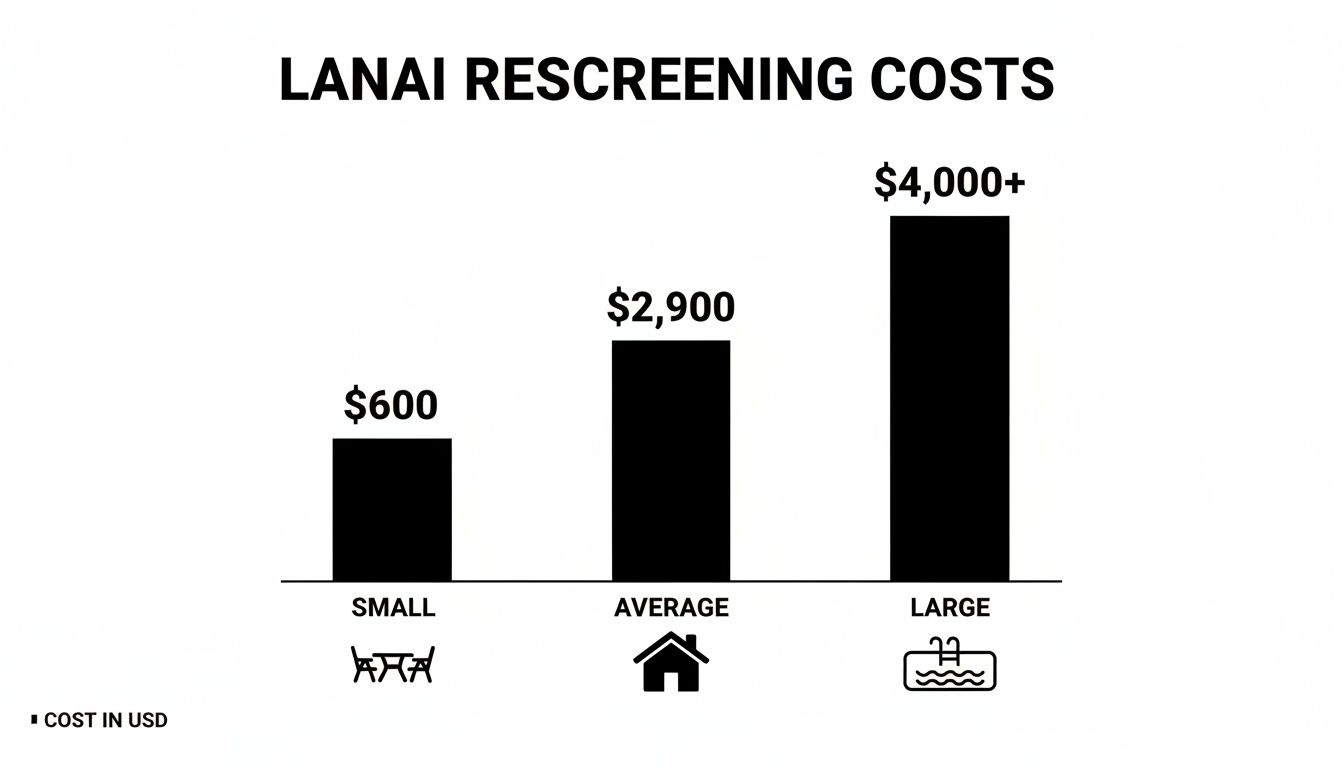
As you can see, the investment grows directly with the size of your space, with a noticeable jump from a basic patio to a full-sized pool cage. Nationally, these numbers are right in line with broader screened-in porch averages, with a typical mid-range project landing around $2,900. Having these ballpark figures in mind helps you budget effectively and sets clear expectations before you start getting quotes.
Breaking Down Your Lanai Rescreening Quote
Getting a quote for a lanai rescreening can feel a little like looking at a car's sticker price. You see the final number, but what exactly are you paying for? If you want to make a smart investment, you need to understand what's behind that total. Let's pull back the curtain and break down the core ingredients of a typical estimate.
Think of your lanai screen replacement cost as a simple recipe with three main parts: the materials, the skilled labor, and the finishing hardware. Each one is critical, and tweaking any of them will change the final price and the long-term durability of your enclosure.
The Foundation: Screen Materials
The biggest chunk of your quote is almost always the screen mesh itself. Just like picking out paint for your house, there’s no single "best" screen—it's all about finding the right balance of visibility, strength, and cost for your lifestyle.
Here are the most common options you'll see in the Tampa Bay area:
- Standard Fiberglass Screen: This is the workhorse of the industry. It gives you good visibility and airflow at a price that’s easy on the wallet, making it a great choice for lanais that aren't exposed to severe weather or playful pets.
- Pet-Resistant Screen: If you have dogs that scratch or cats that climb, this stuff is a lifesaver. It’s a tougher, vinyl-coated polyester screen that costs a bit more upfront but can save you a fortune in repeat panel repairs down the road.
- High-Visibility Screen: Often called "better view" screens, this finer mesh is designed to practically disappear, giving you a crystal-clear, unobstructed view of your beautiful Florida backyard.
- Solar Screen: This screen is built to block a huge portion of the sun's harsh UV rays. Not only does it keep your lanai cooler, but it also protects your patio furniture from fading under that relentless Florida sun.
The Skill: Professional Labor
You're not just buying a roll of screen; you're paying for the expertise and time of a skilled professional. Installing a screen correctly is a craft. It takes precision and experience to get the mesh perfectly taut, secure, and completely free of wrinkles. A sloppy installation leads to premature sagging and tearing, which completely defeats the purpose of getting it done in the first place.
Labor costs cover the entire process—from meticulously removing the old, brittle screen and worn-out spline to carefully installing the new mesh, panel by panel. Billed hourly, lanai screen labor often averages around $35 per hour, but that can climb for more complex jobs. As you can see from these lanai repair cost insights, rescreening a 1,000-square-foot lanai can easily hit $1,500 or more in labor alone, and that's before factoring in any structural work.
The Details: Crucial Finishing Touches
Finally, it’s the little things—the hardware—that often make the biggest difference in how long your new screens will last. This includes the rubber spline that locks the screen into the frame and, most importantly, the fasteners (screws) holding the whole structure together.
The choice between standard screws and stainless steel fasteners is the perfect example of a small decision with a massive impact. Sure, standard screws might save you a few bucks today, but they are guaranteed to rust in our humid climate. Soon enough, you'll have ugly orange streaks running down your enclosure, and eventually, those screws will fail completely.
Investing a little extra in high-quality, corrosion-resistant fasteners is one of the smartest moves you can make. It prevents future headaches and keeps your lanai looking clean and pristine for years. Getting these components right is critical, which is why we explain exactly what is involved with rescreening a pool cage in our detailed guide.
The Hidden Factors That Shape Your Final Price
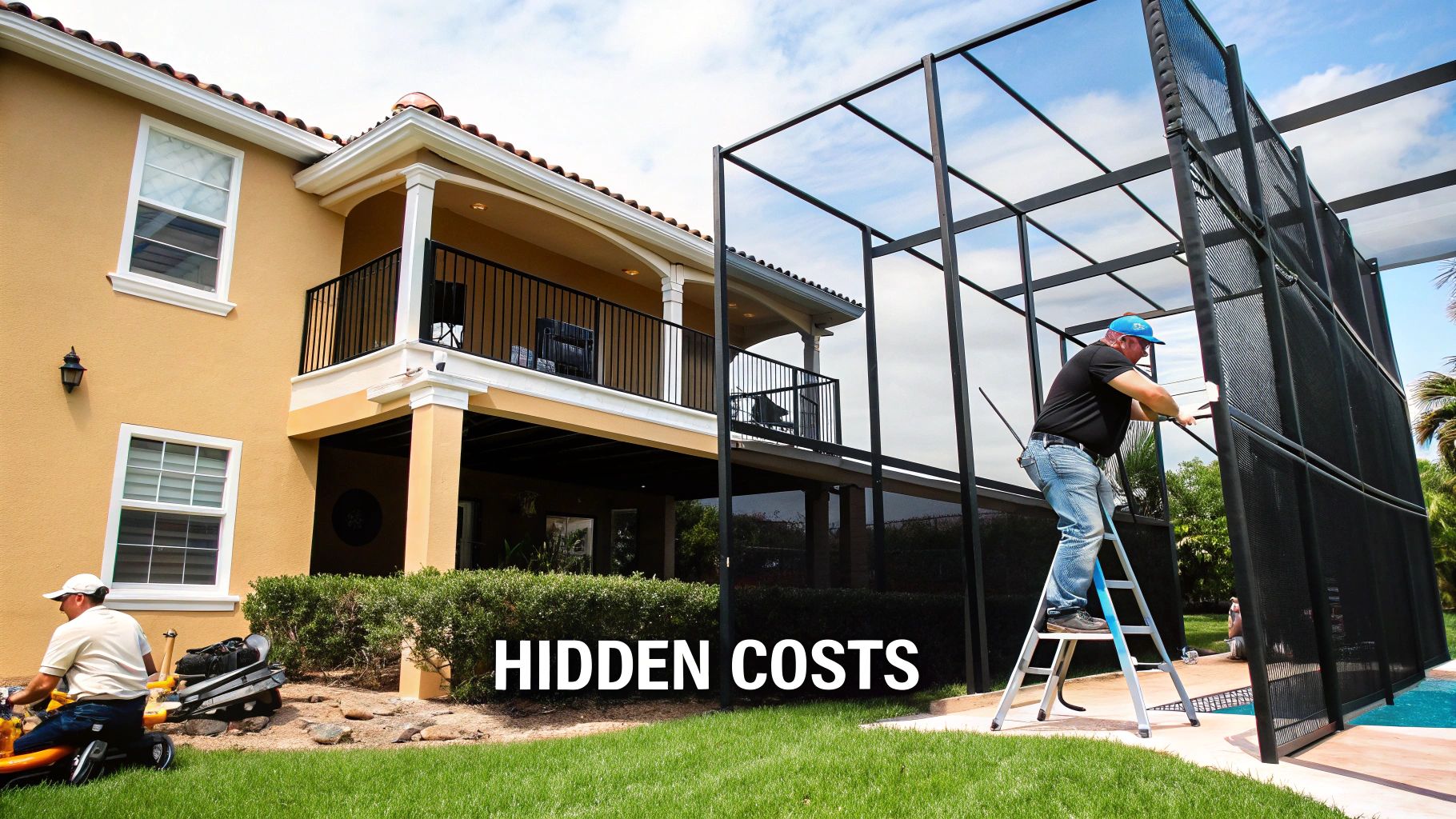
Ever wonder why your neighbor’s rescreening quote came in differently than yours, even though your lanais look almost identical from the street? It’s because no two outdoor enclosures are ever really the same. A handful of behind-the-scenes factors can dramatically influence your final lanai screen replacement cost, turning what seems like a simple job into something much more involved.
Getting a handle on these variables is the key to setting a realistic budget and avoiding sticker shock when the final invoice arrives. Think about it: a crew working on a simple ground-floor patio has a straight shot. But a team tackling a two-story pool cage full of tricky angles is on a completely different mission.
Height and Structural Complexity
The height of your enclosure is probably one of the biggest cost drivers. A standard single-story lanai lets our technicians work fast and safe right from the ground. Easy peasy.
But the moment you go up to a two-story pool cage, you introduce a whole new set of challenges and costs. Now the crew needs specialized gear like tall ladders, scaffolding, or maybe even a lift just to reach the upper panels. That adds significant setup and breakdown time, not to mention a higher level of risk, all of which gets factored into the labor costs. Complex roof designs with lots of angles or domes also require more time and precision, bumping up the price.
The Condition of Your Aluminum Frame
Here's a hard truth: your new screen is only as good as the frame holding it in place. Before we even think about installing new mesh, a true professional will give that aluminum structure a thorough inspection, checking for corrosion, dents, or loose connections. Slapping new screen onto a weak frame is like putting brand new tires on a car with a bent axle—it just doesn't make sense.
Think of your lanai's frame as its skeleton. If that skeleton is weak or damaged, simply putting new 'skin' on it won't solve the underlying problem. Addressing frame issues is essential for a long-lasting, secure result.
If we find problems, like rusted-out sections that need replacing or connections that need to be re-secured, those repairs will be added to your quote. It’s amazing what our Florida climate can do to metal over time; you can learn more about how Florida weather affects your screens in our detailed guide.
Job Site Accessibility and Preparation
Finally, we have to consider how easy it is for our crew to actually get to your lanai. If we can park the truck right next to the work area and haul materials without any obstacles, we can be incredibly efficient.
But if your enclosure is tucked away behind the house and our guys have to lug heavy rolls of screen and all their tools through narrow gates or around delicate landscaping, it adds a surprising amount of time and labor to the job.
On top of that, lanais cluttered with furniture, grills, and a jungle of potted plants need to be cleared before work can start. Most homeowners take care of this themselves, but it's a step that can definitely impact how smoothly the day goes. There are many moving parts that go into a fair quote, and you can learn more about the principles of estimating for service businesses to see the bigger picture. By keeping these "hidden" factors in mind, you'll get a much more accurate idea of your investment.
When To Repair Vs. When To Replace Your Lanai Screen
So, you've got a tear in your lanai screen. The big question is, does this call for a quick patch-up or a complete overhaul? Figuring out that tipping point is the key to making a smart financial decision and avoiding headaches down the road.
Think of your screen enclosure like the paint on a car. If you get one little scratch from a rogue tree branch, a simple touch-up is all you need. But when the Florida sun has baked the paint for years, causing it to fade, peel, and chip all over, dabbing every single spot just doesn't make sense. A full repaint is the only real solution to restore its look and protection. It's the same logic with your lanai screen.
To help you decide, let's break down when a targeted repair is the right call versus when a full rescreening is the smarter long-term investment.
Repair or Replace Your Lanai Screen?
Use this guide to quickly assess your situation and point you in the right direction:
- Scenario: One or two torn panels from a recent storm.
- Recommended Action: Panel Repair
- Typical Cost: $75 – $150 per panel
- Long-Term Consideration: If other screens are old, more panels could fail soon.
- Scenario: Screens are over 8-10 years old and brittle.
- Recommended Action: Full Rescreen
- Typical Cost: $1,200 – $4,000+
- Long-Term Consideration: Resets the clock on your enclosure's lifespan.
- Scenario: Pet scratched a single door panel.
- Recommended Action: Panel Repair
- Typical Cost: $85 – $175 (pet screen)
- Long-Term Consideration: Consider upgrading all lower panels to pet screen.
- Scenario: Multiple panels are faded, chalky, or sagging.
- Recommended Action: Full Rescreen
- Typical Cost: $1,200 – $4,000+
- Long-Term Consideration: A full rescreen restores uniform color and tension.
- Scenario: Small hole (dime-sized) from an ember.
- Recommended Action: DIY Patch or Repair
- Typical Cost: $10 – $150
- Long-Term Consideration: Quick fix, but a professional repair will look better.
- Scenario: Selling your home soon.
- Recommended Action: Full Rescreen
- Typical Cost: $1,200 – $4,000+
- Long-Term Consideration: Boosts curb appeal and signals a well-maintained home.
Ultimately, a few isolated repairs are fine for a newer enclosure, but if you find yourself on a first-name basis with your repair technician, it's probably time to think bigger.
When a Simple Repair Makes Sense
A targeted panel repair is the perfect, budget-friendly fix for isolated, accidental damage. Maybe a stray golf ball found its way to your lanai, your dog got a little too excited, or a single panel gave way during a storm. If the neighboring screens are still in good shape—meaning they feel flexible, have a deep, dark color, and aren't brittle—then just replacing the one bad panel is your most cost-effective move.
This approach is the way to go for:
- Recent, isolated damage: A single hole or tear on an otherwise healthy screen enclosure.
- Budget constraints: When you need a quick and affordable solution to keep the bugs out right now.
- Newer enclosures: If your lanai was screened within the last 5-7 years, the rest of the mesh probably has plenty of life left in it.
For tiny punctures, you might even be tempted to try a DIY patch. Our guide on how to repair window screen holes can walk you through the basics. But for a seamless, professional finish on a lanai panel that matches perfectly, calling in an expert is always your best bet.
Knowing When It's Time for a Full Rescreen
The conversation changes completely when the damage isn't just a one-off incident. Age is the number one enemy of screen mesh here in Florida. Years of UV rays bake the life right out of the material, leaving it brittle, faded, and weak. That one small tear you see today is often a warning shot that the rest of the panels are about to follow.
If your screens are over 7-10 years old, have a chalky, silvery appearance, or you find yourself calling for repairs every few months, you’ve hit the tipping point. Continuing with small fixes is like putting bandages on a failing dam—it's more expensive in the long run than just addressing the root problem.
A full rescreen is a fresh start. It’s a comprehensive project that restores your lanai's beauty, function, and integrity all at once, ensuring you won't be dealing with screen issues again for many years. It's the clear choice when you see widespread wear and tear. This is especially true if you're getting your home ready to sell; a freshly screened lanai is a huge selling point that tells buyers the property has been well-maintained.
Why a Quality Rescreen Is an Investment, Not an Expense
It’s easy to look at the lanai screen replacement cost and just see another number on a bill. But that's the wrong way to look at it. A professional rescreen is really a smart investment in your home’s value, its safety, and your family's quality of life. The upfront cost is a drop in the bucket compared to the much larger expenses you could be staring at down the line.
The clearest comparison? A rescreen versus building a whole new enclosure from the ground up. A professional rescreen is a manageable project that breathes new life into your space. Building a completely new, roof-integrated lanai is a major construction job with a price tag that's often several times higher. By simply maintaining the structure you already have, you’re protecting a significant home asset for a tiny fraction of the cost of starting over.
The True Cost of Doing Nothing
Putting off a rescreening project comes with its own set of hidden—and growing—costs. Ignoring those small tears and brittle mesh doesn't make the problem disappear; it just lets it fester into something far more serious and expensive to fix.
When you choose durable materials and professional installation, you're not just fixing a screen. You are actively preserving your property value, enhancing your family’s outdoor enjoyment, and preventing bigger, more expensive headaches down the road.
This "cost of doing nothing" adds up quickly and includes things like:
- Unchecked Pest Problems: Torn screens are basically a welcome mat for mosquitoes, no-see-ums, and every other bug in the neighborhood, ruining your comfort and creating a health nuisance.
- Sinking Curb Appeal: Faded, sagging, or damaged screens make a home look neglected. That’s not just an eyesore; it can genuinely hurt your property's market value.
- Spiraling Structural Issues: That one small tear in a single panel? It puts extra strain on the entire enclosure, especially when the wind kicks up. This can lead to spline popping out, damage to the aluminum frame, and eventually, the need for a much bigger, more expensive repair job.
A Smart Financial Comparison
Investing in a quality rescreen isn't just about dodging problems; it's a financially sound decision. According to U.S. cost guides, just adding screens to an existing 200-square-foot covered lanai averages around $2,000, or about $10 per square foot.
Compare that to a full lanai build, which can easily run into five-figure territory. For homeowners and property managers here in Tampa Bay, it's a no-brainer. Refreshing your existing enclosure delivers a massive visual and functional upgrade for a relatively small investment. To really see the difference, you can read more about these lanai construction price comparisons and get the full picture.
Choosing The Right Screening Partner In Tampa Bay
The quality of the screen material you pick is only half the battle. The real difference comes down to the skill of the person holding the tools. It’s their expertise that turns your lanai screen replacement cost from a simple expense into a long-lasting investment. In the Tampa Bay area, choosing the right partner is everything.
When you start your search, there are a few non-negotiables. Any true professional will be able to show you proof of their license and insurance without hesitation. This protects you from liability and proves they meet Florida's standards for the job.
Beyond the paperwork, look for a company with a deep-rooted history right here in Tampa Bay. A long track record in our unique climate means they know exactly how to fight back against the relentless humidity, sun, and storms we face every year.
Verifying Quality And Craftsmanship
The best contractors are obsessed with the little details that others might ignore. Don't be shy about asking specific questions—the answers will reveal their true commitment to quality work.
- Fastener Quality: Ask if they use standard screws or corrosion-resistant stainless steel fasteners. The cheap ones will leave ugly rust streaks down your frame in a year; the good ones won't.
- Spline Selection: What kind of spline do they use to lock the mesh in place? High-quality spline holds the screen tighter for much longer, preventing that annoying sag you see on poorly done jobs.
- Workmanship: Do they have a gallery of their completed projects you can look at? Seeing is believing, and real-world examples will give you confidence in their skills.
A true craftsperson stands behind every single detail of their work, from the screen itself down to the smallest screw holding it all together. This commitment is what separates an average job from a beautiful, durable lanai enclosure.
Transparent customer reviews and clear, honest communication are also huge green flags. Checking out a company's past projects gives you a real window into the quality you can expect. An experienced, reputable team ensures your investment is secure for years to come.
Your Top Questions About Lanai Rescreening, Answered
Jumping into a rescreening project can bring up a lot of questions. We get it. To help you plan with confidence, we’ve put together some straightforward answers to the things homeowners in Tampa Bay ask us most often.
How Long Does a Lanai Rescreening Project Usually Take?
You might be surprised how quickly this can get done. For most standard-sized lanais or pool enclosures, a professional crew can knock out the entire job in just one or two days.
Now, if you have a massive, multi-story enclosure or need significant aluminum frame repairs and a full repaint, that timeline might stretch a bit. But any good team will give you a clear, realistic timeline with their estimate, so you know exactly what to expect from start to finish. No last-minute surprises here.
Do I Need a Permit for Lanai Screen Replacement in Florida?
Good news on this front. In most Tampa Bay area municipalities, simply replacing the screen mesh is considered a routine repair and does not require a permit. Think of it like replacing a window pane—you're not changing the structure, just maintaining it.
However, you'll almost certainly need a permit for bigger jobs, like:
- Replacing structural aluminum components of the frame.
- Changing the footprint or size of your enclosure.
- Building a brand-new screen cage from the ground up.
A trustworthy, licensed contractor will know the local codes inside and out and will handle the entire permitting process for you if your project requires it.
What Kind of Warranty Should I Expect for the Work?
Any professional screening company worth its salt will stand behind their work. You should always expect to get a warranty that covers both the labor (the craftsmanship) and the screen material itself.
The exact terms can vary. For example, a premium, heavy-duty screen will often come with a longer manufacturer warranty than a standard one. Don't be afraid to ask for these details upfront—it’s the best way to make sure your investment is protected for years to come.
Ready to get your lanai back in shape and enjoy your outdoor space without the bugs? The team at Rescreen Rescue brings over 20 years of experience to every job, delivering reliable, high-quality screen solutions across the Tampa Bay area.
Let us show you how easy it can be to get your lanai looking its best.