


Picture this: you're relaxing by your Florida pool, drink in hand, without swatting at a single mosquito or fishing leaves out of the water. That's the everyday reality a screen pool enclosure offers. Here in the Sunshine State, these aren't just a luxury—they're practically a necessity, creating a pest-free outdoor living space that completely changes how you use your backyard.
Why a Screen Enclosure is a Florida Essential
In Florida, we live outdoors year-round. Unfortunately, so do the bugs, the blazing sun, and the unpredictable storms. A well-built screen enclosure acts like a protective bubble around your pool and patio, letting you enjoy it all without the usual headaches. Think of it as an investment in your comfort, safety, and your home’s bottom line.
These structures do way more than just keep out the critters. They're your first line of defense against falling leaves, pine needles, and other yard debris. That means a lot less time skimming the pool surface and a lot more time actually swimming in it. A cleaner pool also means you might use fewer chemicals and run your filter less often, which is a nice little bonus.
Key Benefits for Florida Homeowners
The perks of installing a screen pool enclosure in Florida go far beyond just convenience. Homeowners get real, tangible benefits that seriously upgrade their lifestyle and protect their property.
- Pest-Free Living: It creates a comfortable barrier against mosquitoes, no-see-ums, and other biting insects that thrive in our humid climate. Finally, you can enjoy an evening outside in peace.
- UV and Sun Protection: Modern screens for your Florida pool can block a huge percentage of harmful UV rays. This makes your pool area safer for your family and cuts down on that blinding sun glare.
- Enhanced Safety and Security: An enclosure adds a critical layer of safety, helping to keep unsupervised children and pets safely away from the water.
- Increased Property Value: A well-maintained pool enclosure is a huge selling point for homebuyers in Florida. It's an upgrade that often delivers a strong return on your investment when it's time to sell.
The true magic of a screen enclosure is how it seamlessly blends your indoor and outdoor spaces. It basically adds a whole new protected living room to your home—a place to relax, eat dinner, and entertain without fighting off the elements.
At the end of the day, a durable enclosure is all about getting the most enjoyment out of your biggest asset: your home. By creating a cleaner, safer, and more comfortable environment, you unlock the true potential of your Florida backyard. From Tampa Bay to St. Petersburg and Clearwater, this simple addition is a defining feature of the lifestyle we all love.
Choosing Your Enclosure Style and Screen Material
Once you decide a screen pool enclosure is right for your Florida home, you’ll find there’s more to it than just a frame and some mesh. The two biggest choices you'll make are the architectural style of the enclosure and the type of screen material you use. These decisions shape everything—the look, the feel, the durability, and even how much maintenance you'll be doing down the road.
Think of it this way: the frame is the skeleton, and the screen is the skin. Both have to work together perfectly to create a space that’s as beautiful as it is functional. Nailing this combination is all about balancing your budget with what your family really needs for visibility, toughness, and protection from our unique Florida weather.
Finding the Right Architectural Fit
You want your pool cage to look like it belongs with your home, not like an afterthought. The most popular styles for screen pool enclosures in Florida each bring something different to the table, both visually and structurally.
- Dome Roof: This is the classic Florida look for a reason. Its curved design is incredibly strong, fantastic at letting rain and leaves slide right off, and creates a wide-open feeling inside. The straightforward engineering also makes it one of the more budget-friendly options.
- Gable Roof: Often called an A-frame, this style has two sloping sides meeting at a peak, just like the roof on many traditional homes. The design gives you a vaulted ceiling, which can make the whole space feel grander and more airy.
- Mansard Roof: With its flat top and sloped sides, the Mansard offers a boxier, more modern profile. It’s a great choice if you want to maximize the interior height, especially over larger or more complex pool decks.
This diagram really gets to the heart of what every one of these styles is designed to do for you.
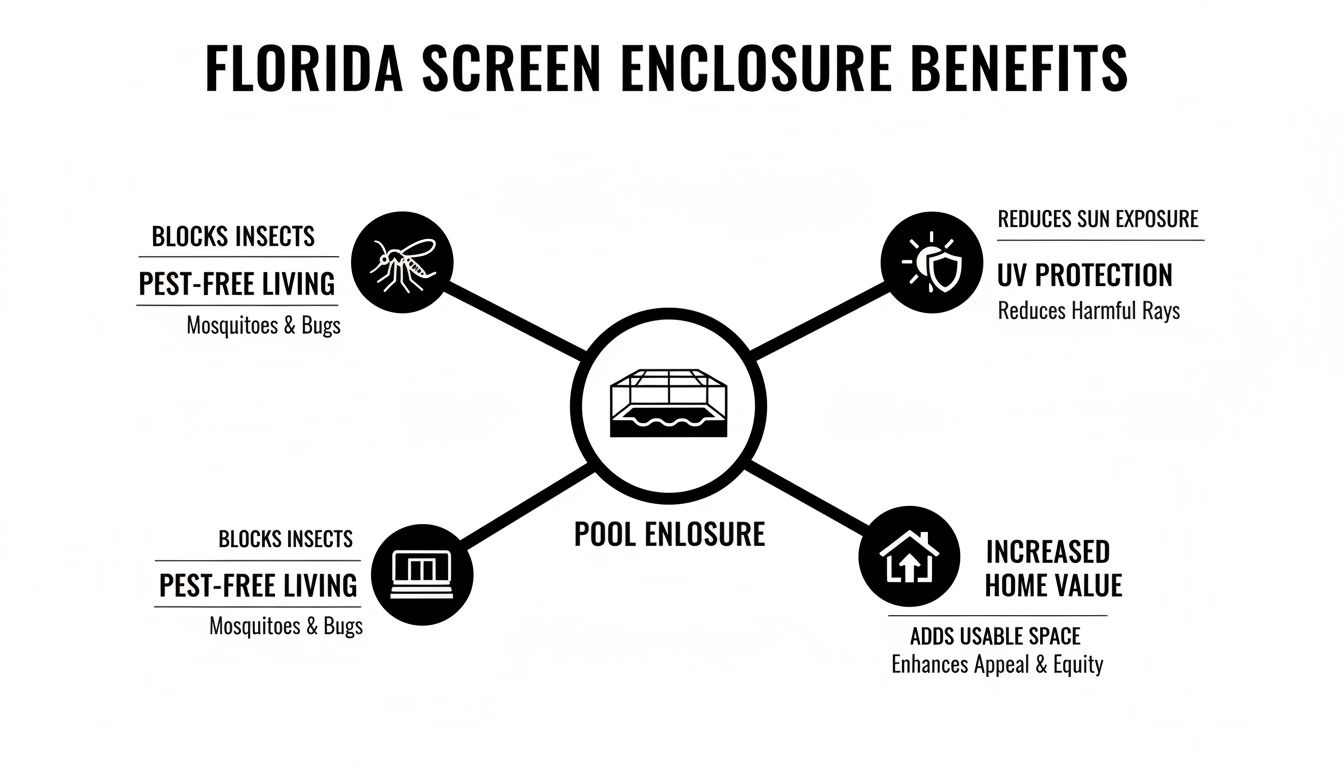
No matter which style you pick, a well-built enclosure fundamentally boosts your quality of life by making your pool area safer, more comfortable, and a bigger asset to your home.
Selecting Your Ideal Screen Material
The screen itself is arguably the most critical part of your entire enclosure. It’s the frontline defense against bugs, debris, and the relentless Florida sun. Thankfully, screen technology has come a long way, giving you options tailored to almost any priority.
For years, the go-to standard has been 18/14 fiberglass screen. Those numbers just refer to the tightness of the weave—18 strands per inch one way, 14 the other. It strikes a great balance between visibility, airflow, and keeping most bugs out, making it a solid, cost-effective choice.
But many homeowners find that upgrading to a specialty screen is well worth the investment. For a deeper dive, check out our guide on the best screen for your porch, which covers many of the same materials we use for pool cages.
Your screen choice is a direct investment in your daily comfort and your enclosure's lifespan. While standard screen works well, specialized options are designed to solve specific Florida problems, from persistent pests to playful pets.
Here are a few of the most popular upgrades and why people choose them:
- 20/20 "No-See-Um" Screen: This tighter mesh is the ultimate weapon against Florida's tiniest biting pests, especially no-see-ums. You might sacrifice a tiny bit of airflow, but for many, enjoying a peaceful evening outdoors makes it a worthy trade-off.
- Pet-Resistant Screen: If you've got dogs or cats, this is a game-changer. It's made from a vinyl-coated polyester that is about seven times stronger than standard screen, so it can handle claws and paws without tearing.
- Florida Glass (Laminated Screen): Don't let the name fool you—this isn't glass. It's a vinyl-laminated screen that is completely waterproof and provides privacy. It’s perfect for the bottom panels of an enclosure to keep out grass clippings, dirt, and splashes from the lawn sprinklers.
- Solar/UV Protection Screen: This screen is specifically engineered to block up to 90% of the sun's heat and damaging UV rays. It keeps your pool deck noticeably cooler, prevents your patio furniture from fading, and just makes the whole area more comfortable on a hot summer afternoon.
Getting a Real Handle on Pool Enclosure Costs
When you’re thinking about a big home improvement project, it’s easy to get hung up on the initial price tag. But a screen pool enclosure is a classic case where the sticker price doesn't tell the whole story. This isn't just another bill to pay; it's a strategic upgrade that pays you back in comfort, cleanliness, and even cold, hard cash when you sell your home.
Let's pull back the curtain on what a new screen pool enclosure in Florida really costs and why it might be one of the smartest investments you can make.
The final price isn't some number pulled out of a hat. It's a custom figure based on a few key variables that determine exactly how much material and labor are needed to get the job done right.
Key Factors Driving the Price
Figuring out what shapes the final quote is the first step to setting a realistic budget. The main cost drivers are pretty straightforward:
- Size and Scope: This is the most direct factor. A larger enclosure covering an expansive deck will obviously need more aluminum and screen, which drives up the overall price.
- Roof Complexity: A simple Dome roof is almost always more budget-friendly than a complex Gable or Mansard style that has to be tied into multiple roof lines on your home. Those intricate designs require more engineering, custom cuts, and a lot more time on-site for the installation crew.
- Material Selection: As we've covered, picking specialty screens like tough, pet-resistant mesh or solar-blocking options will bump up the material cost compared to standard fiberglass. The thickness and grade of the aluminum frame also play a huge part in the final number.
- Local Labor and Permitting: Labor rates can differ across Florida. The cost of pulling permits in counties like Pinellas, Hillsborough, and Manatee will also be baked into your final estimate.
Right now, in Florida's busy market, the average cost for a standard, mid-sized pool screen enclosure—think around 1,500 square feet and built to today's tough building codes—is about $23,000. A good market range to keep in mind is $12 to $25 per square foot for a professional installation.
That price range reflects the heavy-duty engineering needed for Florida's hurricane-prone environment. Homes in coastal high-wind zones will see costs push toward that upper end—$18 to $25 per square foot—because the code demands thicker aluminum, extra K-bracing, more fasteners, and often more complex roof designs.
Framing Your Enclosure as a Smart Investment
Yes, the initial outlay is a chunk of change. But a quality pool enclosure delivers a powerful return on investment that goes way beyond its construction cost. It's not a purchase; it's a long-term asset for your home and your lifestyle, and the financial benefits start ticking up the day the job is done.
A well-maintained pool enclosure is one of the few home improvements that enhances your daily life while simultaneously boosting your property’s market appeal. It’s an investment in both your present enjoyment and your future financial security.
This return shows up in a few tangible ways. First, it adds directly to your home’s resale value. In Florida’s competitive real estate market, a clean, enclosed pool is a huge draw that can bring in more buyers and help justify a higher asking price. If you're also thinking about a smaller project, you might be interested in the factors that influence the cost to build a screened porch.
Then there are the long-term savings, which are pretty substantial. By keeping leaves, dirt, and other gunk out of your pool, you slash your cleaning time. This translates to less wear and tear on your pool pump and filter, lower electricity bills, and a big drop in the amount of chemicals you need to buy to keep the water balanced. Those day-to-day savings really add up, making the enclosure a financially savvy upgrade that actively pays for itself over its lifetime.
Navigating Florida's Strict Building and Hurricane Codes
Here in Florida, building codes aren't just bureaucratic hoops to jump through—they're a critical line of defense. Think of them as a blueprint for survival, designed to protect your family and property when our wild weather kicks into high gear. This is especially true for structures like screen enclosures.
Putting up a pool cage isn't a weekend DIY project. It's a legitimate engineering job that has to meet tough local and state rules before a single piece of aluminum is even cut. If you live in a coastal community like Pinellas, Hillsborough, or Manatee County, the requirements are even stricter because of the higher wind load risks. These codes dictate everything, from the thickness of the aluminum beams to the exact type and spacing of the screws holding it all together.
Demystifying The Permitting Process
Before any construction starts, a permit from your local building department is a must. This is a non-negotiable step. Trying to build without one is a recipe for disaster, leading to massive fines, orders to tear down your brand-new structure, and major headaches when you try to sell your home down the road.
Getting a permit means submitting detailed engineering plans for your enclosure. These blueprints prove the design meets all the codes, particularly for wind resistance. A reputable, experienced contractor handles this entire headache for you—from drafting the plans and submitting them to the county to scheduling all the necessary inspections.
Built To Withstand Florida Storms
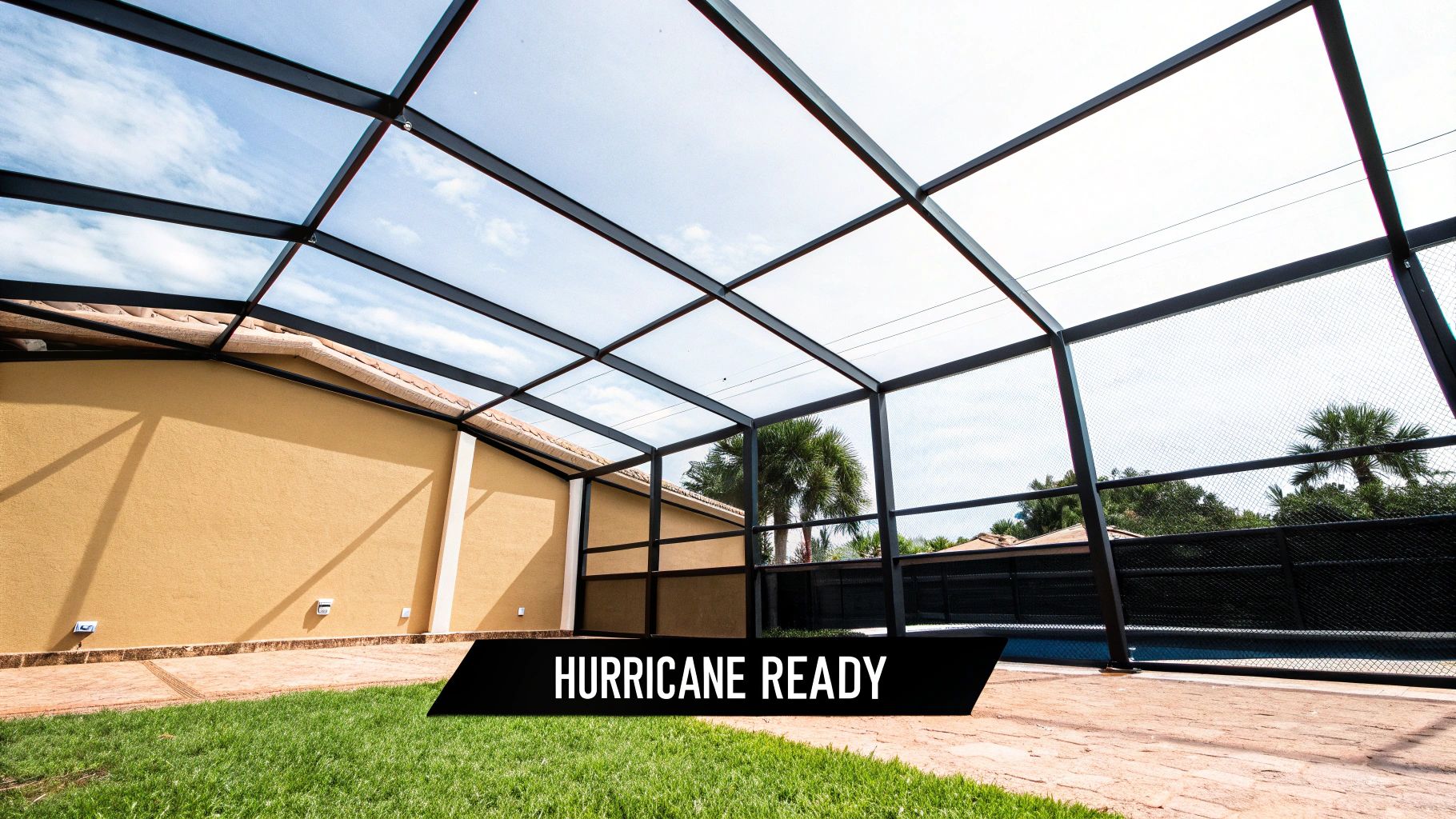
Let's be clear: Florida's building codes are written with hurricanes in mind. For screen enclosures, the single most important factor is wind load—the immense force that high-speed winds exert on the structure. Modern codes demand that enclosures be engineered to handle specific wind speeds, which can be as high as 150 mph or more in our coastal areas.
This isn't just about using a few extra screws. It's achieved through specific engineering features:
- Heavier Gauge Aluminum: The structural beams are significantly thicker and stronger than what you'd find in a standard kit.
- Specialized Fasteners: Every connection point uses high-strength, corrosion-resistant bolts and screws designed to resist being ripped apart by violent winds.
- Reinforced Bracing: You'll see strategic "K-bracing" or "wind bracing" in the corners and across long spans. This is what gives the cage crucial stability against sideways forces.
An enclosure built to today’s code is like a ship built for rough seas. While nothing is truly "hurricane-proof," a modern structure is designed to flex and endure, dramatically lowering the risk of a catastrophic failure during a major storm.
This focus on durability is why so many Floridians continue to invest in their outdoor spaces. Even with market shifts, the state's pool industry remains strong. In 2025, new pool permits were down only about 3% year-to-date through September, showing that homeowners are still actively improving their properties. That's where screen specialists come in, whether it's repairing storm damage or completely rescreening a lanai to meet modern standards.
Preparing Your Enclosure For Storm Season
Even a rock-solid, code-compliant enclosure needs a little prep work before a storm rolls in. Your best defense is regular maintenance. Before hurricane season officially kicks off, do a quick walk-around and look for any potential weak spots.
Check for loose or missing screws, paying close attention to the base where the frame is bolted to your concrete deck. Look for any small rips or tears in the screen panels—the wind can catch these easily and turn a tiny hole into a giant one. For a more detailed checklist, check out our guide on how to protect your screens during natural disasters and hurricanes. Taking these simple steps can make a huge difference in how well your enclosure weathers the storm.
Smart Repair and Restoration Solutions
Living in Florida means dealing with a powerful combination of intense sun, high humidity, and the occasional hurricane. Over time, even the most robust screen pool enclosures will start to show some wear and tear. It’s inevitable. UV rays break down the screen fabric, and storms can leave behind unwelcome damage.
The key is knowing how to tackle these issues head-on to keep your outdoor oasis safe, functional, and looking its best. The good news? Not every little problem demands a full-blown replacement. Understanding the difference between a simple patch-up and a major overhaul can save you a ton of hassle and money.
Panel Repair Versus Full Rescreen
Figuring out when to fix a single panel versus replacing all the screen is a common dilemma for homeowners. Think of it like dealing with tires on your car—sometimes you just need to patch a single puncture, but other times, you really need a whole new set for safety and performance.
-
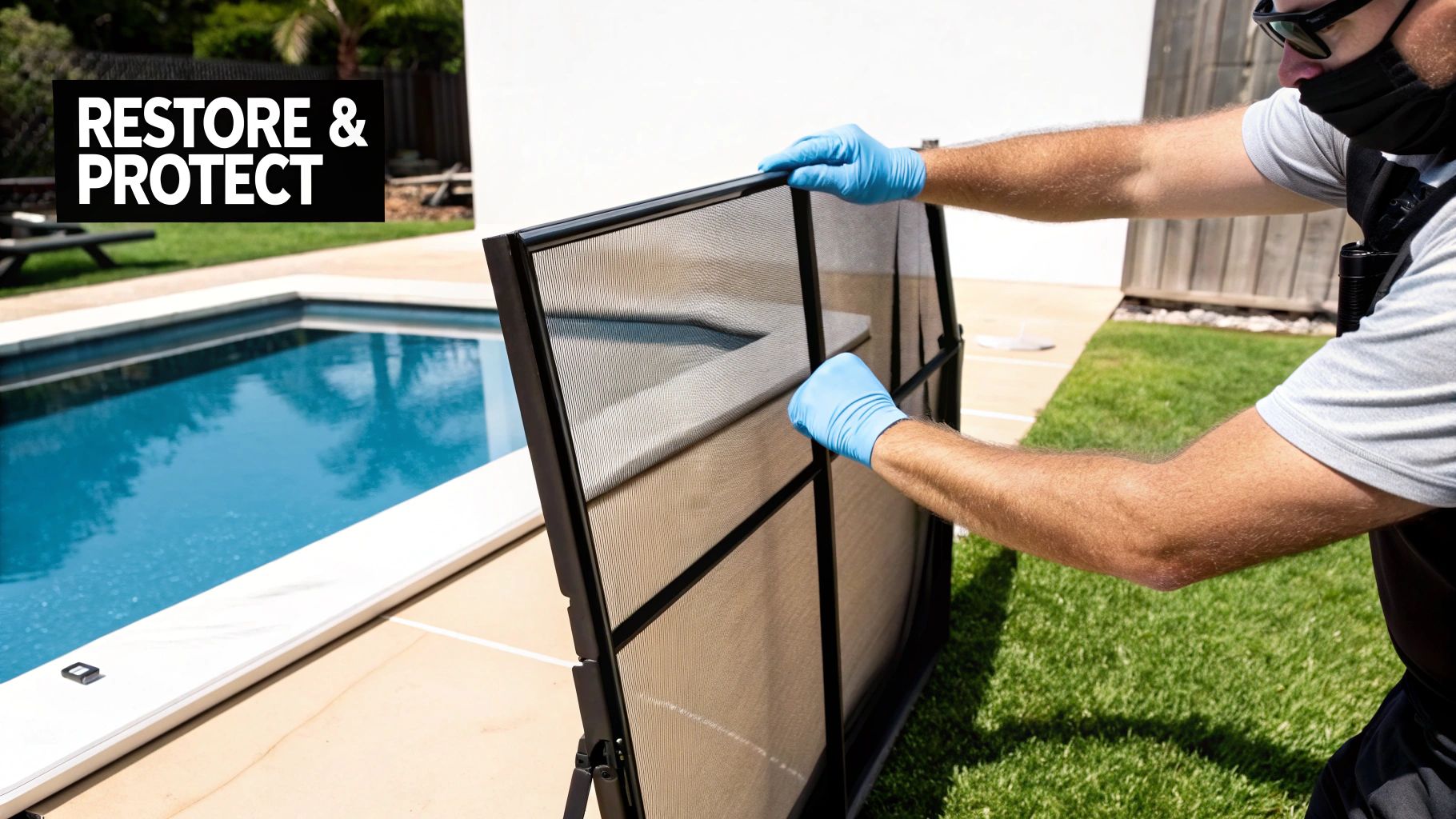
When to Opt for a Panel Repair: If a stray branch or an accidental poke from the pool skimmer leaves you with one or two tears, a targeted panel repair is your best bet. As long as the surrounding screens are still in good shape, this is a quick and budget-friendly fix.
-
When It’s Time for a Full Rescreen: If you're seeing multiple torn panels, the screen feels brittle, or it leaves a chalky residue when you touch it, that's your sign. The screen has reached the end of its life. A full rescreen ensures everything is uniformly strong and looks cohesive, saving you from the frustrating cycle of chasing down new rips every few months.
The global market for screen enclosures hit a massive $2.5 billion in 2023, and a huge chunk of that demand comes from climates just like ours. Here in Tampa Bay, a well-kept enclosure can even bump up your home's value by as much as 8%. It makes smart upkeep a seriously good investment. You can find more details about the value of porch screens in our area on our blog.
Comprehensive Restoration Services
Sometimes, the screens themselves are holding up, but the metal structure looks faded, stained, or just plain old. This is where a full restoration comes in. It can breathe new life into a tired enclosure for just a fraction of what a total replacement would cost.
A full restoration is more than just a repair; it’s a renewal. By addressing the frame, fasteners, and overall cleanliness, you're essentially turning back the clock on your enclosure, restoring its original strength and aesthetic appeal.
This isn't just about looks; it's about structural health. Key restoration services include:
- Professional Pressure Washing: This is the first step for a reason. It blasts away years of built-up algae, mold, and grime from the aluminum frame and screens, making the whole structure look brighter instantly.
- Fastener Replacement: Those old, rusty screws are the weakest link in your enclosure. We swap them out for high-quality, corrosion-resistant fasteners to restore the structure's integrity—a must-do for hurricane season.
- Professional Painting: A fresh coat of specialized paint does two things: it protects the aluminum from more corrosion and oxidation, and it completely transforms the look of your pool cage, making it feel brand new again.
How to Hire the Right Screen Enclosure Contractor
Choosing the right team for your pool enclosure isn't just another item on your to-do list—it's the most critical decision you'll make for the entire project. This is a significant investment in your home. The quality of the installation directly impacts its lifespan, safety, and how it holds up to our wild Florida weather.
Finding a trustworthy partner means your project runs smoothly and leaves you with a structure that looks great and stays strong for years. It's about more than just getting a few quotes; it's about doing your homework to verify who you're letting work on your home. An unprepared or unprofessional contractor can turn a dream project into a costly, frustrating mess. Arming yourself with a simple checklist is the best way to spot the real pros.
Your Contractor Vetting Checklist
Don't be shy about asking questions and checking credentials. Any reputable contractor will be happy to show you their paperwork and answer your questions. If they hesitate or get defensive, that's a major red flag. Think of it as an interview for an important job—because that's exactly what it is.
Before you even think about signing a contract, make sure you verify these non-negotiables:
- Proper Licensing and Insurance: This is ground zero. Always ask for proof of a valid Florida contractor's license. Just as crucial, confirm they carry both liability insurance and workers' compensation. This is what protects you from being financially on the hook if an accident happens on your property.
- A Detailed Written Estimate: A verbal quote or a handshake deal is a recipe for disaster. A professional estimate is a detailed document that breaks everything down: material costs, labor, permit fees, and the specific type of screen and aluminum they plan to use.
- Verified Local Experience: You want a company with a proven history of building and repairing screen pool enclosures in Florida. Look them up online, read reviews, and ask to see a portfolio of their recent projects. A great contractor will gladly give you local references you can actually call.
Key Questions to Ask Every Potential Contractor
Once you've got the basics covered, it's time to dig a little deeper. The way a company answers these next few questions will tell you everything you need to know about their standards, their process, and their commitment to quality work. And if you're curious about what makes the best local companies stand out, understanding some actionable contractor marketing tips shows how the pros build their reputation in Southwest Florida.
Hiring a contractor is about establishing trust. A team that communicates clearly, offers transparent pricing, and guarantees their work is a team you can rely on to protect your investment.
Before you make a final call, be sure to ask:
- What specific materials will you be using? Get the details. Ask for the gauge of the aluminum and the brand and type of screen.
- What does your warranty cover? You need to know exactly what’s covered (both materials and labor) and for how long.
- Who will be on-site managing the project? Knowing who your point of contact is makes communication much easier if issues pop up.
- How long will the project take, and what is the payment schedule? A clear timeline and fair payment milestones are there to protect both you and the contractor.
Taking these simple steps will help you find a reliable partner you can trust with your home. For more ideas on how to breathe new life into an existing structure, check out our guide on finding expert pool cage restoration near me.
Your Top Questions About Florida Pool Enclosures, Answered
Alright, let's wrap this up by tackling some of the most common questions we hear from Florida homeowners. Getting straight answers helps you plan your project with confidence and make the right call for your home, budget, and lifestyle.
How Long Does A Pool Enclosure Actually Last?
A well-built aluminum frame for a screen pool enclosure in Florida can easily last 30 years or even more if you take care of it. Think of the frame as the skeleton—it's built for the long haul.
The screen mesh itself is a different story. It typically needs replacing every 7 to 15 years. The exact lifespan really depends on the quality of the material you choose, how much direct sun it gets, and how many storms it weathers. A little regular maintenance goes a long way in stretching the life of both the structure and the screen.
Do I Really Need A Permit To Build Or Rescreen?
Yes, for a brand-new screen enclosure, a permit is pretty much always required in Florida. This process ensures the structure is properly engineered to handle our local building codes for wind resistance and safety. It's not just red tape.
For a full rescreen, the rules can vary from county to county. The best move is to work with a licensed contractor who knows the local regulations inside and out. Simple single-panel repairs? You usually don't need a permit for those.
The permitting process is not just a formality; it's a crucial safety check that verifies your enclosure is built to withstand hurricane-force winds, protecting both your property and your family.
Can I Paint My Old, Faded Enclosure?
Absolutely. In fact, a professional paint job is one of the best ways to bring an old, chalky-looking enclosure back to life. Contractors use specialized paints that are formulated to bond directly to aluminum and stand up to Florida's brutal sun and humidity.
This isn't just about looks, either. A fresh coat of paint adds a protective layer against future oxidation and corrosion, which can add years to your frame's life.
How Often Should I Clean My Enclosure?
A light cleaning once or twice a year is usually all it takes to keep your enclosure looking sharp. A gentle rinse with a garden hose will knock off most of the loose dirt, pollen, and cobwebs.
For tougher grime or mildew spots, a soft-bristle brush and a mild soap solution will do the trick. Just be sure to avoid harsh chemicals or high-pressure washing—that's a fast way to damage the screen's protective coating and shorten its lifespan.
Ready to transform your outdoor living space with a beautiful, durable screen enclosure? The experienced team at Rescreen Rescue provides expert repair, rescreening, and restoration services across Tampa Bay. Contact us today for your free, no-obligation estimate!