


It's easy to spot a massive rip in your pool screen after a storm, but most of the time, the signs that you need a full rescreen are far more subtle. It's the slow, creeping wear and tear that really tells the story.
Knowing When To Rescreen Your Pool Enclosure
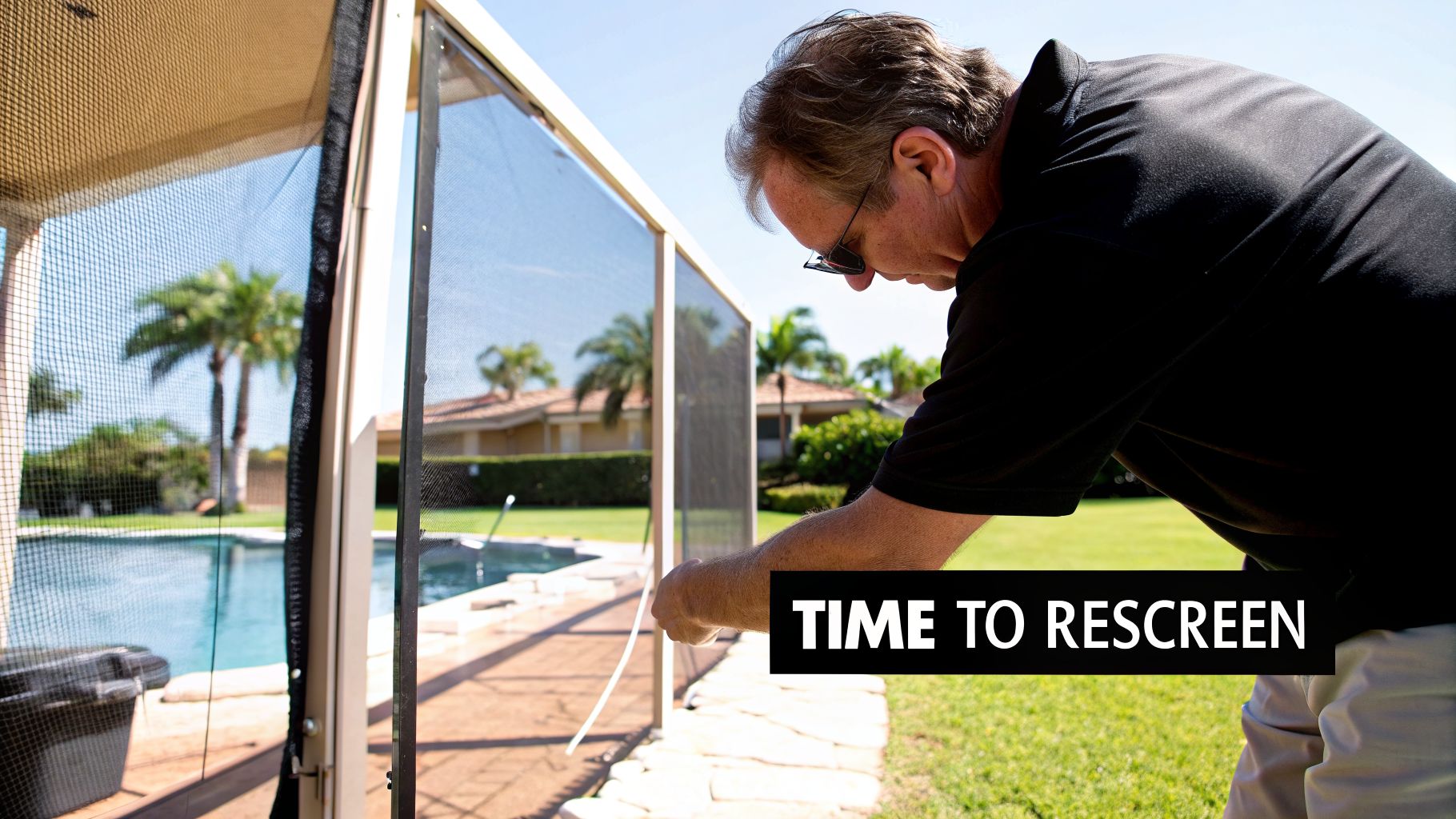
In the Tampa Bay area, a pool enclosure isn't a luxury; it's a core part of enjoying your home. But it’s not a feature you can just set and forget. Florida’s one-two punch of intense sun and salty, humid air works relentlessly to break down screen materials. Regular check-ups are a must.
Waiting for a tree branch to punch a hole through a panel is a reactive approach. A proactive inspection helps you catch the little problems before they turn your outdoor oasis into a bug-infested headache.
Telltale Signs Your Screens Are Failing
Forget about the big, obvious holes for a second. The real clues are more subtle.
A simple touch test can reveal a lot. Go out and feel your screen. Does it feel flexible and springy? Or is it stiff, brittle, and almost crunchy? If it’s the latter, its lifespan is just about over.
Another dead giveaway is the color. Screens that were once a deep, rich black start to look chalky gray or even silver. This isn't just a cosmetic problem—it's a clear signal that the UV-protective coating has completely worn off, leaving the fiberglass threads underneath exposed and weak.
The single most overlooked sign is the spline. That's the rubbery cord holding the screen in the aluminum channel. If it’s cracking, pulling away from the frame, or looks shrunken, the screen's tension is shot. This leads to sagging panels and tiny gaps for pests to sneak through.
Why Florida's Climate Is So Tough On Screens
The same subtropical climate that makes Tampa Bay a paradise is incredibly harsh on any exterior material. That relentless UV radiation is the number one enemy, breaking down the vinyl coating on the screen mesh and making it fragile. For enclosures that get blasted by the sun all day, this process happens even faster.
Then you have the salt air, especially in coastal communities like St. Pete and Clearwater. Salt doesn't just eat away at the screen; it corrodes the metal fasteners holding the entire cage together. That’s why a true professional rescreening job always includes a hardware inspection.
Real-World Scenarios For Rescreening
Thinking about putting your house on the market? A faded, sagging pool enclosure is a huge red flag for potential buyers. A real estate agent in St. Petersburg will tell you that recommending a rescreen is one of the easiest ways to boost curb appeal and perceived value, often leading to a quicker sale.
Or consider a Clearwater HOA that needs to maintain community standards. A uniform, clean appearance is everything. Making sure pool enclosures are rescreened in a timely manner keeps the neighborhood looking pristine and helps uphold property values for everyone.
A surprisingly large number of residential pools in the United States are over 20 years old, which is driving a massive need for services like rescreening pool enclosures to keep them safe and functional. With roughly 60% of the nation's 10.7 million residential pools built before 2005, screen degradation is an incredibly common issue. In fact, statistics show that a fresh rescreen not only restores your enclosure's purpose but can also boost a home's value by up to 7%.
Knowing how often you should rescreen your pool enclosure in Florida can save you from surprise repairs and help you plan for this essential maintenance.
Picking The Right Screen Material For Your Florida Lifestyle
Choosing the right screen for your pool enclosure is one of the most important decisions you'll make in a rescreening project. It's about more than just looks; the material you pick directly affects durability, the clarity of your backyard view, and how well it keeps out Florida's notorious pests. This isn't a one-size-fits-all situation.
The best choice really boils down to your specific needs. A family with a couple of big, rowdy dogs has totally different requirements than someone whose Bradenton home backs up to a quiet nature preserve. Your lifestyle and environment should be the ultimate guide.
Standard Fiberglass Screen: The All-Around Choice
The most common material you'll see on pool enclosures is the standard 18/14 fiberglass mesh. What do those numbers mean? It's simply the weave density: 18 threads per inch horizontally and 14 vertically. This screen strikes a fantastic balance between airflow, visibility, and protection from everyday bugs like houseflies and larger mosquitoes.
For most homeowners in the Tampa Bay area, this is the reliable, cost-effective workhorse. It does a great job keeping the usual backyard pests out of your pool area so you can relax without constantly swatting things away.
That said, its standard strength means it isn't the perfect fit for every scenario, especially if you need extra toughness or a defense against tinier intruders.
Pet-Resistant Screen: For Your Four-Legged Family Members
If you’ve got energetic dogs or curious cats, you already know how fast they can shred a standard screen. This is where pet-resistant screen saves the day. It’s made from a vinyl-coated polyester that's roughly seven times stronger than traditional fiberglass.
This heavy-duty material is built to handle claws, paws, and the occasional full-body lean from a determined pet. We often recommend installing it just on the lower panels of a pool cage—the high-impact zones. This gives you durability where it counts without blocking the beautiful view from the upper sections. It's a smart, targeted upgrade that prevents constant repair calls.
No-See-Um Screen: For Maximum Pest Protection
Florida is home to some of the tiniest, most irritating insects around, especially the dreaded "no-see-ums" (biting midges). A standard screen's weave can sometimes be just large enough for these minuscule pests to wiggle through. That’s where the 20/20 mesh, known as No-See-Um screen, comes in.
This screen has a much tighter weave—20 threads per inch in both directions—creating a formidable barrier that stops even the smallest bugs in their tracks. When deciding on a screen, it helps to know what you're up against. Understanding the common mosquito species in Florida can really highlight why a tighter mesh might be necessary for your property.
The trade-off for this amazing pest protection is slightly less airflow and a bit lower visibility. But for homes near coastal marshes, lakes, or conservation areas where no-see-ums are a constant battle, it is an absolute game-changer.
To make the decision a little easier, here’s a quick breakdown of the most popular options we install.
Comparing Popular Pool Screen Materials
- Standard Fiberglass: Best for general use, balancing airflow and bug protection. It offers good durability and excellent visibility at an affordable cost.
- Pet-Resistant: Ideal for homes with dogs, cats, or active children. Its durability is excellent, with good visibility, at a moderate cost.
- No-See-Um (20/20): Necessary for properties near water, woods, or marshlands. It has very good durability and good visibility, also at a moderate cost.
- Solar Screen: Best for reducing heat, glare, and UV damage. This option provides very good durability but only fair visibility, and it comes at a higher cost.
Ultimately, choosing the right screen is a balance of your top priorities. If you need more guidance on what works best for different outdoor spaces, check out our insights on selecting the best screen for your porch. Whether you're trying to preserve a waterfront view, fend off golf balls, or just keep your pets contained, the right screen material makes all the difference in enjoying your Florida home to the fullest.
What Happens During A Professional Rescreening
When you picture a rescreening pool enclosures project, you might just think it’s a simple swap—old screen out, new screen in. But what we do is a whole lot more involved. A professional job is a precise, step-by-step process that guarantees a drum-tight finish that can stand up to our wild Florida weather. The real difference between a quick DIY and a professional rescreening is in the details you don't see.
It all starts long before a new roll of screen is even touched.
Starting With A Clean Slate
First things first, we have to get rid of every last bit of the old, failing screen. Our crew works panel by panel, methodically pulling out the brittle, cracked spline—that’s the rubber gasket holding the screen in the frame. This isn't just demolition; it's our first chance to inspect the bones of your enclosure.
As the old screen comes off, our technicians get a good look at the aluminum channels. These grooves collect years of dirt, pollen, and decomposed bits of old spline. A common mistake in a DIY job is leaving that gunk behind. If you do, the new spline can't get a proper grip, which leads to a weak, saggy screen.
A pro crew will clean out every single inch of those channels. This creates the perfect, clean foundation for a tight, wrinkle-free screen that will actually last.
Getting The Tension Just Right
Once the frame is prepped and clean, the real craft begins. This is where you can spot an experienced installer immediately. Rolling in a new screen is all about feel—a delicate balance of technique and pressure to get that perfect tension.
If it’s too loose, the screen will sag and flap annoyingly in the wind. But if it's too tight? You risk putting too much stress on the aluminum frame, or the screen could even tear under pressure from a stray golf ball or a heavy storm.
Achieving that flawless finish involves a few key moves:
- Cutting to Size: We cut each panel slightly oversized. This gives us the room we need to stretch and trim it perfectly.
- Rolling with Skill: Using specialized spline rollers, our techs apply steady, even pressure to lock the screen in. We work methodically across the panel, gently stretching the mesh to remove every bit of slack.
- Smoothing It Out: Any tiny wrinkles or puckers are skillfully worked out during the rolling process. The result is that smooth, almost invisible finish you expect.
This is exactly why professionally installed screens look so much better. The tension is perfectly consistent across the entire cage, from the highest roof panel down to the door.
The type of screen you choose, of course, plays a big part in this. Denser materials require a slightly different technique.
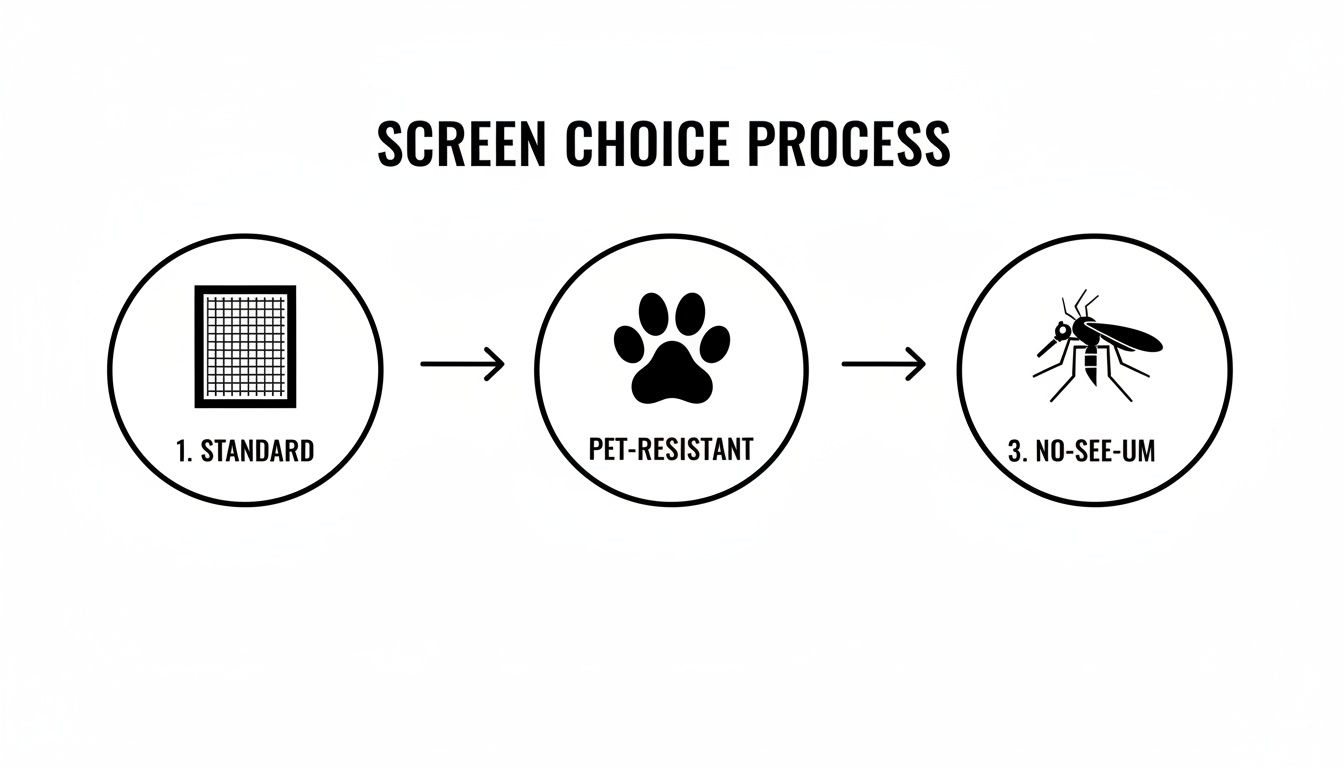
As you can see, moving from Standard to a tougher Pet-Resistant or a fine-mesh No-See-Um screen means working with a less forgiving material, which is where experience really counts.
Upgrading The Hardware: Your Enclosure’s Unsung Heroes
Here’s one of the most important parts of the job that often gets completely overlooked: the hardware. The screws holding your pool cage together are constantly battling moisture, salt, and sun. Over the years, cheap steel screws rust and corrode, silently weakening the entire structure.
A reputable company will never just screen over rusty hardware. It’s a huge red flag if they do. During the rescreening, our technicians inspect every single fastener.
Any screw showing even a hint of rust gets replaced. The same goes for any low-quality, non-coated screws we find. This is non-negotiable, especially in coastal spots like St. Pete or Clearwater where the salt air just eats metal alive. We only use high-quality, corrosion-resistant fasteners built for Florida.
This isn't just about looks; it's about safety and longevity. We’re not just giving your pool cage a new skin—we’re reinforcing its skeleton.
The Final Touches and A Spotless Cleanup
The job isn’t done when the last screen is in. The true mark of a professional is leaving your property looking better than we found it.
Our final pass includes:
- Trimming any excess screen for clean, sharp lines.
- Wiping down the frame to remove any fingerprints or dust.
- Doing one last walkthrough to make sure every panel is perfect.
- Bagging up and hauling away all the old screen, spline, and rusty screws.
You should never be left with a mess to clean up. We handle the complete disposal, leaving you with nothing but a beautiful, fully restored pool enclosure ready for you to enjoy.
Beyond New Screens: A Full Pool Enclosure Restoration
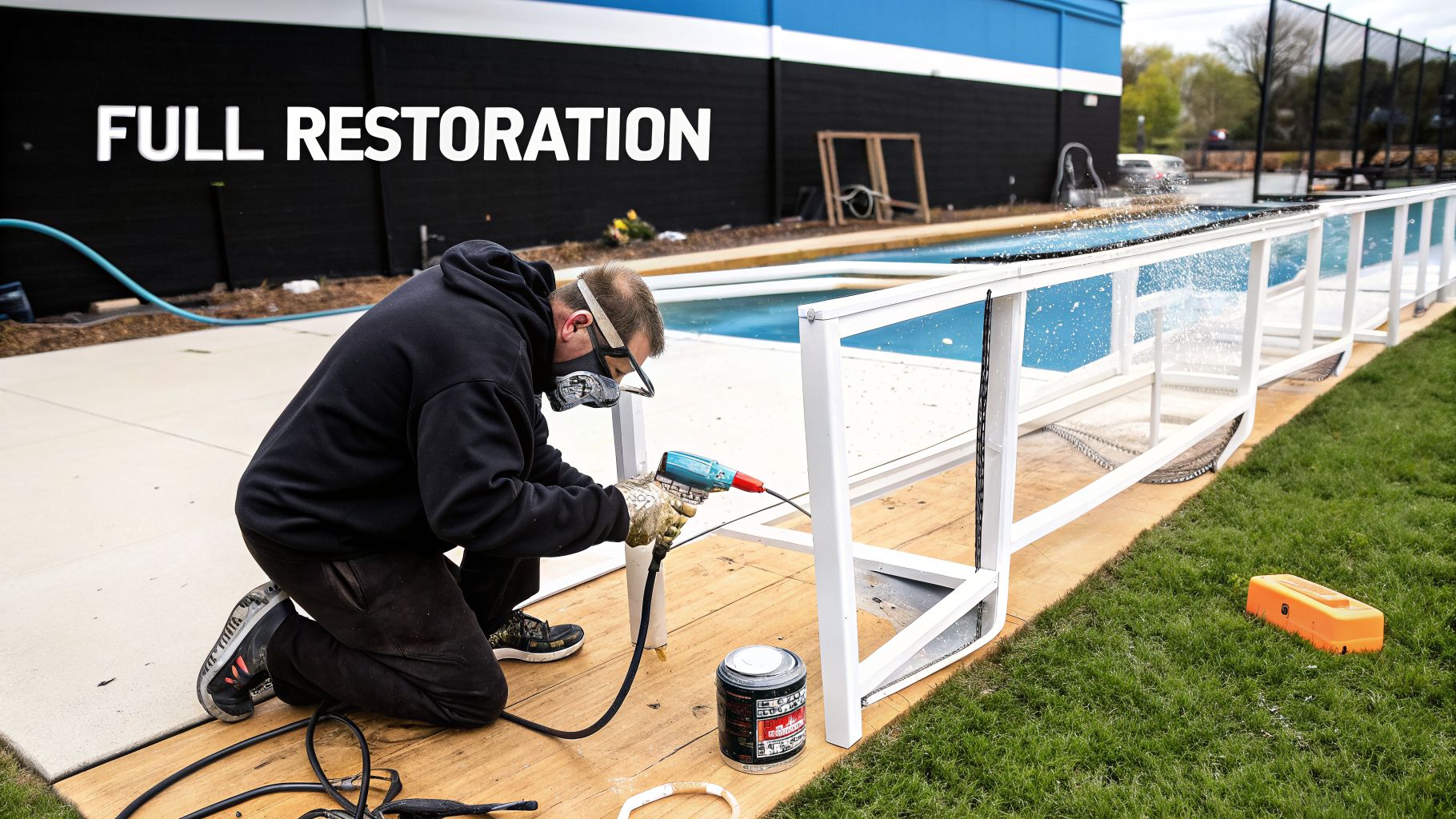
While a full rescreen gets rid of torn panels and makes your outdoor space usable again, the screen itself is really only half the story. Just think about what the aluminum frame of your pool enclosure goes through year after year under the intense Florida sun and humidity. The paint starts to fade, get chalky, and eventually chip away. Mildew finds a home in the crevices, making the whole structure look tired and neglected.
This is exactly where a full pool enclosure restoration comes into play. It’s a comprehensive process that goes way beyond just rescreening pool enclosures to completely bring the metal frame back to life. This approach can take a cage that’s been standing for decades and make it look like it was installed yesterday—often for a lot less than a total replacement.
The Foundation Of A Lasting Finish
Anyone who's ever painted anything knows that a beautiful, durable finish is all about the prep work. You can't just spray a fresh coat of paint over dirty, oxidized aluminum and expect it to last. The first and most critical step is an incredibly thorough cleaning process.
We kick things off with a detailed pressure washing to blast away years of caked-on grime, algae, mildew, and that chalky old paint. This step alone makes a huge difference, revealing the true state of the metal underneath and giving the new paint a perfectly clean surface to bond to.
Once it's clean, it’s time for sanding. Every single inch of the aluminum frame gets carefully scuffed and sanded down. This not only removes any leftover loose paint but also etches the metal, creating a microscopic texture that helps the primer and paint grab on for a rock-solid, long-lasting bond.
Painting With The Right Materials
In Florida's punishing environment, not just any can of paint will cut it. Slapping standard exterior paint on an aluminum pool cage is a recipe for disaster. It will inevitably peel, bubble, and fade under the constant barrage of UV rays and moisture.
The only real choice here is a high-quality Direct-to-Metal (DTM) paint. This isn't your average paint; it's a specialized coating engineered to bond directly with metal and formulated with inhibitors that actively fight corrosion. A professional-grade DTM paint is built to handle:
- Intense UV Rays: It’s packed with pigments that resist fading and chalking from the sun.
- High Humidity: Its chemical makeup stops moisture from creeping under the paint film, which is what causes ugly blistering.
- Salt Air: For homes near the coast, a corrosion-resistant paint is non-negotiable to protect the aluminum from breaking down.
Using the right paint is the secret to a finish that won't just look good next month, but will stay vibrant and protective for years to come.
A complete restoration is more than a cosmetic update; it's a structural refresh. It combines the visual appeal of a brand-new enclosure with the practical benefits of reinforced integrity, adding real, tangible value to your property.
Upgrading Hardware For Ultimate Durability
Just as crucial as the paint job are the thousands of tiny components holding your enclosure together. During a proper restoration, every single piece of hardware should be on the chopping block. Those old, rusty screws are the absolute weakest link in any pool cage.
We swap out every last one with superior, corrosion-resistant options. This isn't a partial upgrade; it's a complete overhaul that includes:
- New Screws: Every screw holding the cage together is replaced with high-performance fasteners designed for harsh coastal conditions.
- Upgraded Tapcons: The big bolts anchoring your enclosure to the concrete deck are replaced with stronger, corrosion-proof versions.
- New Door Hardware: We replace the hinges, handles, and closers so your doors operate smoothly and securely again.
This hardware refresh is one of the most vital parts of rescreening pool enclosures and restoring them the right way. It strengthens the entire structure from the ground up, getting it ready to face whatever Florida's storm season throws at it. When you combine fresh paint, all-new hardware, and new screens, you aren't just making a repair—you're performing a total restoration. You can get a deeper look at what goes into a full renovation and the value it adds by exploring the costs of pool cage restoration.
Figuring Out Costs, Timelines, and How to Get Ready
When you're thinking about a pool enclosure rescreening, a few big questions usually pop up right away: How much will this set me back? How long is my pool area going to be a construction zone? And what do I need to do to prepare?
Getting clear answers to these from the start makes the whole experience so much smoother. It’s all about setting expectations so there are no surprises—just a seamless path to getting your beautiful outdoor space back.
Breaking Down The Cost of a Rescreen
The final price tag on a rescreening project really comes down to a few key things. No two pool cages are built the same, so the cost reflects the unique details of your enclosure.
The biggest factors are easily the size of your enclosure and the type of screen you choose. A massive, two-story pool cage in Tampa is obviously going to need more material and time than a simple lanai on a St. Petersburg bungalow. On top of that, if you decide to upgrade from a standard fiberglass screen to something specialized like a Pet-Resistant or No-See-Um mesh, that will affect the price, too.
A few other things can nudge the final quote up or down:
- Hardware Replacement: The number of rusty, old fasteners that need to be swapped out for new ones.
- Structural Repairs: Sometimes the aluminum frame itself needs a little TLC before new screens go on.
- Accessibility: How easy or difficult it is for our crew and equipment to get to your enclosure.
For a really deep dive into all the specifics that go into pricing, check out our guide on the cost to rescreen a pool enclosure.
It's worth noting that this is a growing need. The global market for swimming pool enclosures is expected to jump from USD 1.2 billion to USD 2.1 billion by 2033, and a huge part of that is driven by the regular maintenance and rescreening these structures need. With fixed enclosures making up 40% of all installations and needing new screens every 7-10 years, there's a constant demand for skilled pros to keep them safe and looking good. You can read more about these trends in the swimming pool enclosure market.
What To Expect For A Project Timeline
"How long will this take?" It's one of the first questions we always get. While every job has its own quirks, you'll be happy to know that most full rescreening projects on standard-sized enclosures are wrapped up in just one to two days. Our crews have this down to a science and work efficiently to keep the disruption to your daily life at a minimum.
The whole process is pretty straightforward:
- Initial Estimate: We'll come out and give you a free, no-pressure quote.
- Scheduling: We’ll lock in a date that works best for you.
- Project Day: Our team shows up on time and gets to work.
- Final Walkthrough: Once we’re done, we’ll walk the project with you to make sure you’re 100% happy.
A professional team respects your time. The mission is always to deliver top-quality work as quickly and cleanly as possible so you can get back to enjoying your bug-free pool.
Your Homeowner Preparation Checklist
A little prep work on your end can make a huge difference in how smoothly the project goes. Taking care of a few simple things before we arrive helps us work faster and keeps your property safe.
- Clear the Deck: Please move all your patio furniture, grills, potted plants, and pool toys out from inside and around the enclosure. This gives our team a clear, safe space to work.
- Provide Access: We'll need to be able to get to a water spigot and an electrical outlet. These are essential for some of our tools and the final cleanup.
- Secure Your Pets: For their safety and ours, please make sure any pets are kept securely inside your house while we're working.
- Trim Back Landscaping: If you have bushes, vines, or tree branches touching or hanging over the cage, trimming them back two or three feet is a massive help.
Ticking off these items helps us stay on schedule and focus completely on giving your pool enclosure the flawless, professional rescreening it deserves.
Common Questions We Hear About Rescreening
Even after walking through the entire rescreening process, you probably still have a few questions. We get it. This is a big decision for your home, and the details matter. We've put together answers to the most common questions we hear from homeowners across the Tampa Bay area, from St. Pete to Clearwater.
Think of this as that final chat over the fence where we clear up any lingering concerns before you move forward.
How Long Will My New Screens Actually Last?
This is easily the number one question we're asked, and the honest answer is: it depends on a few key factors. For a professionally installed, high-quality standard fiberglass screen, you can expect a solid 8 to 10 years of reliable performance. That's assuming it doesn't meet a stray golf ball or the full force of a hurricane, of course.
The specific material you choose makes a huge difference, too.
- Pet-Resistant Screen: This stuff is tough. Built with a heavy-duty polyester, it often outlasts standard screens, giving you 10 to 12 years or even more.
- Solar Screen: As a premium option, solar screen is also built for the long haul. Its robust construction means it can easily last well over a decade.
Here in Florida, the sun is the biggest enemy of your screens. An enclosure tucked away in the shade will naturally hold up longer than one that gets baked in direct sunlight all day. A little TLC, like a gentle cleaning to wash off dirt and pollen, also goes a long way in extending its life.
Can You Just Replace One Or Two Damaged Panels?
Absolutely. If you’ve just got a couple of torn panels from a falling branch or a mishap with the weed whacker, a single-panel repair is almost always the most budget-friendly choice. We do these kinds of targeted repairs all the time.
But there's a "but" you need to consider. If the rest of your screens are getting on in years—looking faded, feeling brittle—that brand new panel is going to stick out like a sore thumb. The color will be a much deeper black, and it will look totally out of place next to the weathered, graying screens around it. If your whole enclosure is showing its age, a full rescreen is a much better investment. It gives you a clean, uniform look and prevents you from having to call us back in a few months when another old panel inevitably gives out.
For a deeper dive into when a quick fix makes sense versus a full overhaul, you can learn more about our approach to pool enclosure screen repair.
Will A Rescreening Project Damage My Pool Deck Or Landscaping?
A true professional crew prides themselves on leaving your property looking better than when they arrived. We are incredibly careful around your pool deck, patio furniture, and all the landscaping you’ve worked so hard on.
Our technicians use ladders with rubber footings and are trained to work with precision. We never drag our equipment across pavers, and we make sure every last bit of old spline and hardware is contained. The only thing we want to leave behind is a flawless new screen enclosure.
A final, thorough cleanup is a non-negotiable part of our process. We bag up all the old material and debris and haul it away, leaving your space ready to enjoy immediately. Protecting your home is our top priority.
What Is The Difference Between A Lanai, Patio, And Pool Enclosure?
You'll hear these terms thrown around a lot, and while people often use them interchangeably, they do have slightly different meanings. A pool enclosure, or what many call a "pool cage," is that big aluminum structure covering your entire swimming pool and a good chunk of the deck.
A lanai or patio enclosure is typically smaller, covering a porch or patio area that’s attached to the house. It’s essentially a screened-in outdoor room.
From our perspective as installers, the job is pretty much the same. We use the same top-tier materials and meticulous techniques whether we're screening a small lanai or a massive two-story pool enclosure. The only real difference is the square footage. If you have more general questions about pools beyond just the enclosure, these Pool FAQs are a great resource.
Ready to bring your outdoor oasis back to life? The team at Rescreen Rescue has over 20 years of experience delivering fast, reliable, and beautiful screening solutions for homeowners and property managers all over Tampa Bay. Get your free, no-hassle estimate today.