


Picture this: you're finally kicking back in your Tampa Bay lanai with a cold drink, ready to enjoy the sunset, when a mosquito starts buzzing in your ear. Then another. Suddenly, you realize a small tear in your screen has turned your peaceful retreat into an all-you-can-eat buffet for bugs.
It’s a classic Florida problem, and it’s why professional screened lanai repair isn't just a nice-to-have—it’s essential for truly enjoying your home. This is about more than swatting away pests; it's about protecting your investment and your sanity.
Why Screened Lanai Repair Is Essential For Florida Homeowners
Here in Florida, a lanai isn't just a screened-in porch. It's an outdoor living room. It's where you sip your morning coffee, host weekend cookouts, and decompress after a long day. But the very things we love about our state—the bright sun, thick humidity, and salty coastal air—are in a constant battle with your screen enclosure.
Think of your lanai screen as the first line of defense for your outdoor comfort. Over time, those relentless UV rays bake the mesh, making it brittle and faded. The humid, salty air, especially in places like St. Petersburg and Clearwater, goes to work corroding the metal fasteners and weakening the frame itself.
What starts as a tiny rip from a fallen branch can quickly become a gaping hole, an open invitation for mosquitos, no-see-ums, and every other flying nuisance.
More Than Just Keeping Bugs Out
A well-maintained screen enclosure does a lot more than just keep pests on the outside looking in. It’s a surprisingly critical part of your home's overall health and safety.
A few key benefits you might not have considered:
- Preserves Property Value: In the competitive Tampa Bay real estate market, a clean, fully intact lanai is a huge selling point. A damaged one is a red flag.
- Enhances Safety: A sturdy screen keeps small children and pets from wandering off while also preventing curious critters like snakes or raccoons from wandering in.
- Reduces Debris: Forget constantly sweeping. Intact screens are fantastic at blocking leaves, pine needles, and other yard debris from messing up your patio and getting into your pool.
The need for screened lanai repair is a booming necessity in Florida. The global screen enclosure market grew to $2.5 billion in 2023, with a significant portion driven by repairs in humid, buggy climates just like ours.
This guide is your complete roadmap to understanding everything about screened lanai repair. From spotting subtle signs of wear and tear to figuring out the right repair options, we'll walk you through what every Florida homeowner should know.
Your lanai is a core part of your home, and we're here to help you keep it in top shape. If you're curious about the structure itself, you can learn more by checking out our guide on what a lanai screen enclosure is.
How To Inspect Your Lanai Screen For Common Problems
Before you can fix a problem, you need to know exactly what you’re dealing with. A thorough walk-around inspection of your screen enclosure is the first step, turning you from a worried homeowner into an informed one who knows what to ask for. Think of it as a quick health check for your lanai—catching small issues now saves you from major repair headaches down the road.
Some problems are impossible to miss, like a gaping hole from a stray golf ball or a branch that came down in a storm. But other issues are far more subtle. Your lanai fights a daily battle with Florida's sun, humidity, and wild weather, and that constant exposure leads to all kinds of wear and tear.
Obvious and Hidden Damage to Look For
The best way to start is to walk the perimeter of your enclosure on a bright, sunny day. Look at each panel one by one, both from a distance and up close.
You’ll likely spot a few common culprits:
- Small Rips and Tears: Check near the bottom of the panels. These are often caused by pets, weed whackers, or patio furniture getting pushed up against the screen.
- Large Holes: Usually from a direct impact, like storm debris or an accident. These are open invitations for every bug in the neighborhood.
- Brittle or Faded Screens: Years of harsh UV rays will bake the life right out of screen mesh. If you touch a panel and it feels crunchy, stiff, or chalky, it’s at the end of its lifespan.
But the screen mesh is only part of the story. A screen is only as strong as the frame and fasteners holding it all together.
Structural Integrity and Spline Issues
The sneakiest problems often hide in the little details. Pay close attention to the spline, which is the rubber cord tucked into the aluminum frame that holds the screen tight. Florida’s heat and sun cause this spline to dry out, shrink, and eventually lose its grip.
When you see a screen panel pulling away from the frame or looking wavy and loose, it's almost all a sign of failing spline. This might seem like a small cosmetic issue, but it compromises the whole panel, which can easily pop out completely during a strong gust of wind.
Another critical spot to check is the hardware. The screws and bolts holding your enclosure together are prone to rust, especially here in Tampa Bay’s salty, humid air. Look for tell-tale orange or brown stains running down the aluminum from the screw heads.
Corroded fasteners are a serious structural red flag. They signal a weak point in the frame that could lead to a catastrophic failure during a hurricane. A simple visual check helps you spot these weak links before they become a disaster, and it's a non-negotiable part of any professional screened lanai repair assessment.
To help you diagnose what you're seeing, here’s a quick reference guide. Use it to match the problem you find with the most likely solution.
Lanai Screen Problem and Recommended Action
- Problem: Small Tear (<3 inches)
- Common Cause: Pet claws, sharp objects, weed whackers
- Recommended Action: DIY patch kit for a temporary fix; professional patch for a cleaner look.
- Problem: Large Hole (>3 inches)
- Common Cause: Storm debris, accidents, fallen branches
- Recommended Action: Partial rescreen of the entire affected panel. Patching is not effective.
- Problem: Sagging or Wavy Screen
- Common Cause: Failing spline, stretched mesh from wind
- Recommended Action: Partial rescreen of the panel, ensuring new spline is installed.
- Problem: Brittle or Faded Screen
- Common Cause: 10+ years of UV exposure
- Recommended Action: A Full rescreen is recommended, as other panels are likely in similar condition.
- Problem: Rust Stains on Frame
- Common Cause: Corroded steel screws
- Recommended Action: Replace all old fasteners with ceramic-coated or stainless steel screws.
- Problem: Bent or Damaged Frame
- Common Cause: Impact from a major storm or accident
- Recommended Action: Structural repair or replacement of the damaged aluminum section.
This guide should give you a solid idea of whether you’re looking at a quick fix or a more involved project. Armed with this knowledge, you can confidently decide on your next steps.
Understanding Your Lanai Repair And Restoration Options
So, you've found a tear in your lanai screen. Now what? You're at a crossroads, with options ranging from a quick DIY fix to a full-blown restoration. Making the right call comes down to the age of your enclosure and just how bad the damage is, ensuring you put your money toward a solution that will actually last.
A lot of people's first instinct for a small hole is to grab a patch kit from the hardware store. While it might seem like a good idea, think of it as a small bandage on a bigger problem. They're often noticeable, tend to peel off in the relentless Florida sun, and do absolutely nothing for the brittle, aging screen all around the patch.
From A Single Panel To A Full Rescreen
When a simple patch isn't going to do the job, the next step up is replacing just the one damaged panel. We call this a partial rescreen, and it’s a great choice for isolated damage—like when a stray branch takes out a single panel on an otherwise healthy, newer enclosure. We just remove the old screen and spline from that one section and pop in a new one for a seamless fix.
But here’s the thing: if your enclosure is already seven to ten years old, a full rescreen is almost always the smarter, more cost-effective move. Once one panel gets brittle enough to tear, you can bet the others aren't far behind. A full rescreen tackles every panel at once, giving your entire enclosure a fresh start with uniform strength and appearance.
This decision tree can help you figure out where your damage falls and what to look for beyond just the obvious holes.
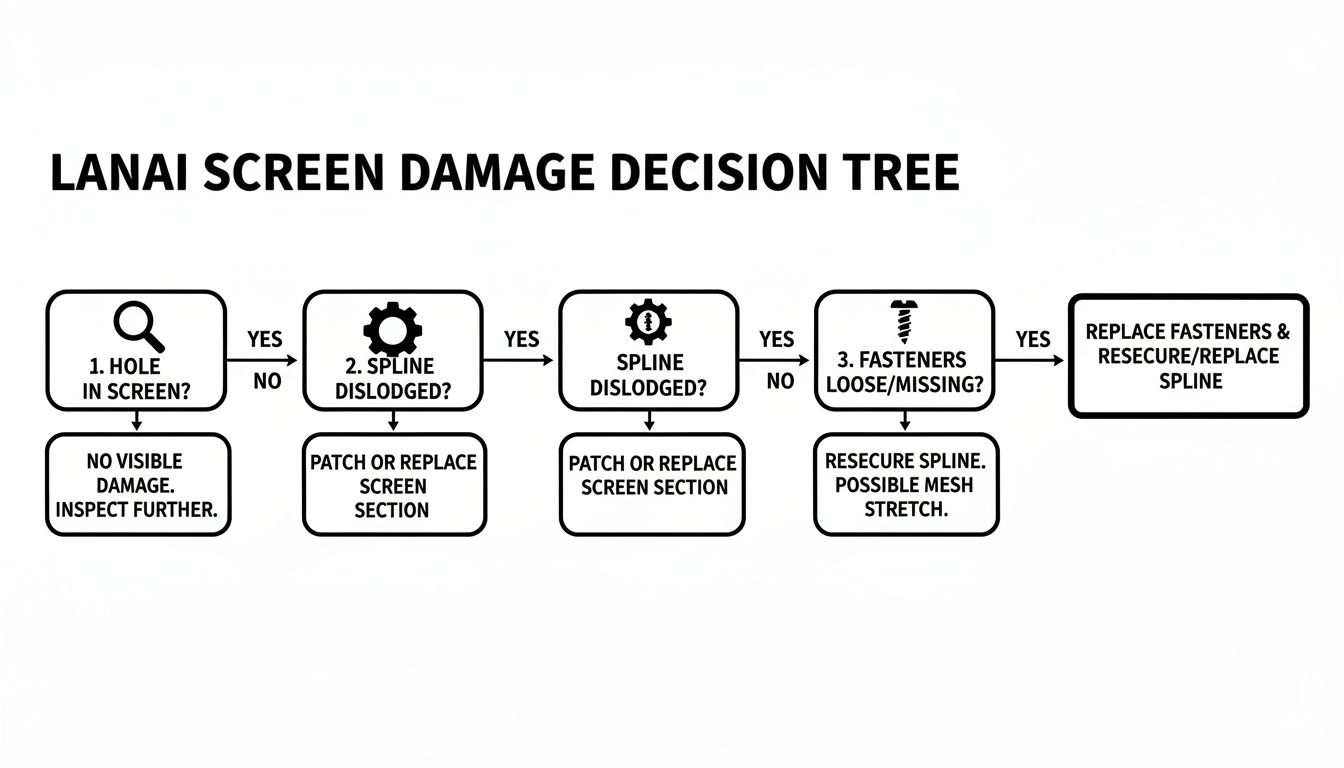
As you can see, a proper inspection means checking the screen, the spline holding it in, and the fasteners holding the whole structure together. They're all equally important.
Structural Repairs And Full Restoration
Sometimes the issues are more than screen-deep. During an inspection, we might find aluminum frame pieces that were bent during a storm or, more commonly, fasteners that are covered in rust. This is when structural repairs are no longer optional—they're essential for safety.
Ignoring rusty hardware is one of the biggest mistakes you can make in Florida. The constant salt and humidity will chew through standard steel screws, compromising the integrity of your entire enclosure. Any legitimate screen repair job should include replacing those old, corroded fasteners with high-quality, corrosion-resistant hardware. It's non-negotiable.
For homeowners who want to completely overhaul their outdoor space, a full restoration is the way to go. This top-tier service bundles a full rescreen and any needed structural repairs with extras, like painting the entire aluminum cage. This not only makes your lanai look brand new but also adds a crucial layer of protection against the elements. You can dive deeper into what a full-scale project involves in our article on pool enclosure screen repair.
Estimating Screened Lanai Repair Costs in Tampa Bay
Let's talk numbers. When you're planning for a screened lanai repair, the first question on just about everyone's mind is, "How much is this going to set me back?" The honest answer is: it depends. But our goal is to give you a completely transparent look at the typical price ranges here in the Tampa, St. Petersburg, and Clearwater areas so you can budget with confidence.
Knowing what goes into the cost helps you see the real value you're getting. Whether you're just replacing a single torn panel or doing a full rescreen on a large pool cage, the scope of the project is what really drives the final price.
Key Factors That Influence The Price
The total cost for your lanai repair isn't a simple flat rate. It’s really a mix of the materials used, the labor involved, and the specific condition of your enclosure right now.
Here’s what we look at when we put together a free, no-obligation estimate:
- Total Square Footage: This is the biggest piece of the puzzle. A larger lanai or pool cage just plain requires more screen material and more time to get the job done right.
- Type of Screen Material: You've got options beyond the standard stuff. Choosing a more durable, pet-resistant mesh or a high-visibility "no-see-um" screen will cost more upfront but brings some great added benefits.
- Extent of Structural Repairs: If the job is more than just screen—like replacing rusted-out fasteners or fixing bent aluminum frame pieces—the price will naturally go up.
- Accessibility and Height: A second-story lanai or a cage with a super high roof might mean we need specialized equipment and some extra time, which can nudge the labor costs.
The need for screened lanai repair is a fact of life thanks to Florida's weather. Hurricanes like Ian back in 2022 absolutely shredded thousands of enclosures, causing a massive spike in repair work all across Tampa Bay.
While you might see national averages for porch rescreening that swing wildly from $187 to $21,000, smaller, more common repairs here in the Tampa area usually land somewhere between $400 and $1,500. You can see more about how those numbers break down by checking out these repair cost statistics on Angi.com.
Getting A Clear And Honest Estimate
Because every single screen enclosure is a little different, the only way to get a truly precise number is with an on-site look. We make that part simple and totally stress-free.
Our team will come out to your home, take a careful look at your lanai, talk through what you need, and give you a detailed estimate that outlines every cost involved. This way, there are zero surprises, and you know exactly what you’re paying for.
For a deeper dive into all the details, check out our full guide on lanai screen repair costs.
DIY Screen Repair vs Hiring A Professional
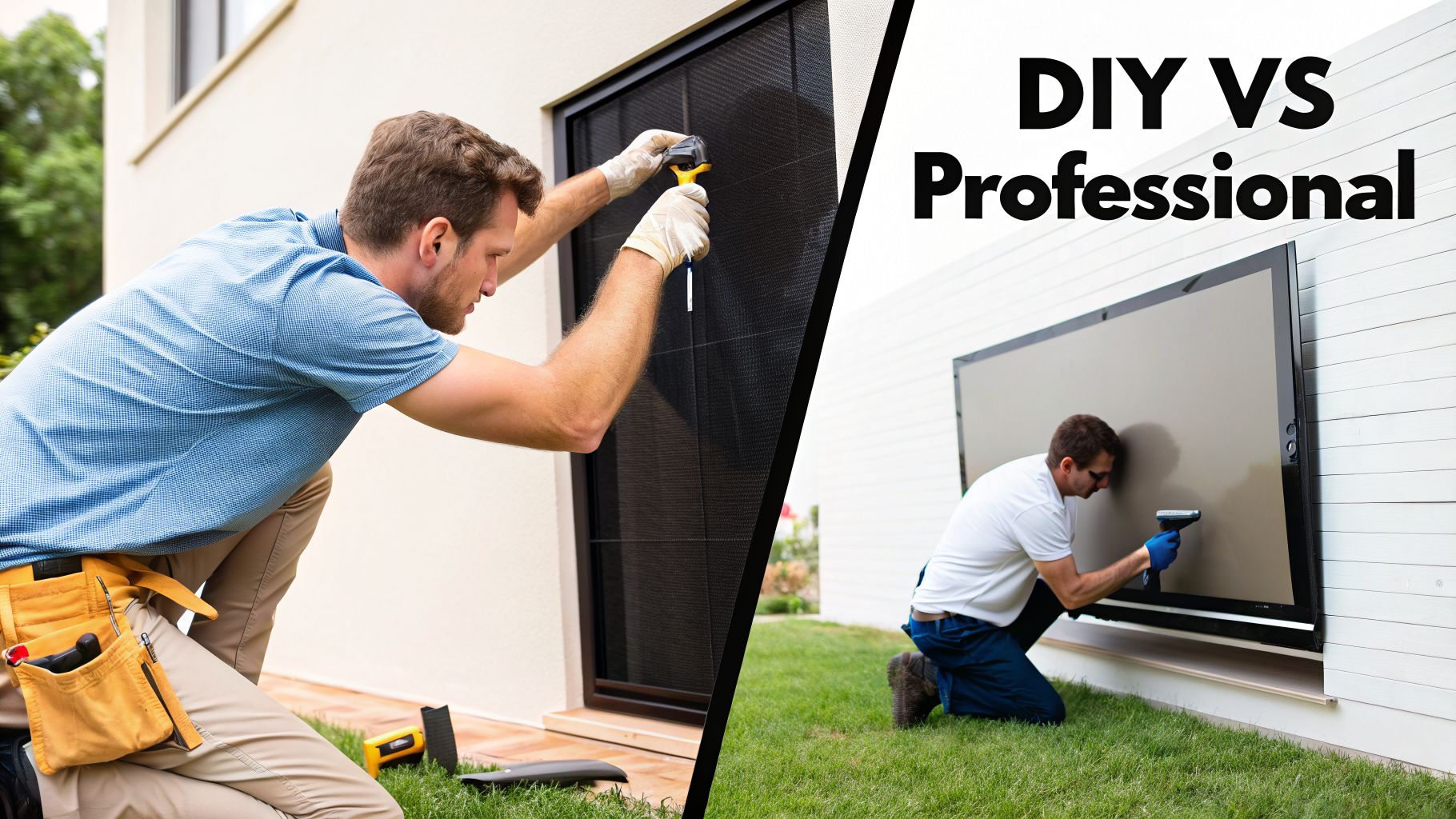
When you spot a torn screen panel, the urge to handle the screened lanai repair yourself is strong. After all, the DIY route seems like a quick and budget-friendly fix. But the reality is often far more complicated, especially when you're dealing with the large exterior screens on lanais and pool cages—not just a simple window or door screen.
The do-it-yourself path is more than just grabbing a roll of screen from the local hardware store. Getting that professional, drum-tight finish is a learned skill, one that requires specialized tools and the right touch. Without them, you’re often left with a saggy, wrinkled panel that not only looks bad but won't hold up to Florida's wind and rain.
The real cost of DIY screen repair isn't just the materials. It's the frustration of an imperfect finish, the safety risks of working on ladders, and the high chance you'll have to redo the whole job much sooner than you think.
The Challenges Of A DIY Approach
For a homeowner trying to repair a large exterior screen for the first time, the learning curve is surprisingly steep. It’s not just about stretching the mesh; you have to pick the right diameter and type of spline to lock the screen into the aluminum frame. Use the wrong size, and the whole panel could pop right out during the next gusty storm.
On top of that, consider these common DIY pitfalls:
- Specialized Tools: A clean, tight installation demands professional-grade tools. A basic utility knife and a cheap roller from a kit often just aren't enough to get the job done right.
- Safety Risks: Climbing a ladder to reach upper-story panels or a high pool cage is genuinely risky without proper training and safety gear.
- Material Quality: The screen material sold at big-box stores is rarely the same commercial-grade quality that professionals use. That means it can break down much faster under the intense Florida sun.
To make an informed choice, it helps to understand the general ways pros outperform DIY in other home projects. The same core principles—expertise, efficiency, and quality—absolutely apply here.
The Value Of A Professional Repair
Hiring a licensed and insured contractor for your screened lanai repair brings a peace of mind and long-term value that easily outweighs any initial savings from a DIY attempt. Professionals show up with years of experience, making sure every single panel is installed perfectly taut and secure. They work safely and efficiently, often finishing a complete rescreen in just one day.
Most importantly, a professional job is backed by a guarantee. You get the assurance of quality work and durable, commercial-grade materials built to last. If you want to see what the process involves, our guide on how to replace patio screens breaks it down. Ultimately, investing in a professional is about protecting your home's value and ensuring your outdoor oasis stays a bug-free retreat for years to come.
Protecting Your Investment With Maintenance And Warranties
Getting your lanai professionally repaired is a smart investment in your home and your family’s comfort. But after the work is done, how do you make sure it holds up for years to come? It really boils down to two things: a solid warranty from your contractor and a simple maintenance routine you can stick with.
Any good company will stand behind their work with a warranty that covers both the screen material and the labor to install it. This is your peace of mind. It’s a promise that if a screen starts to sag or a spline pops out way too soon, they’ll come back and fix it without you having to shell out more money.
Here at Rescreen Rescue, we're all about building relationships in our community. That’s why we’re proud to offer discounts for military personnel, first responders, and seniors—it's our small way of saying thank you for everything you do.
Simple Maintenance For Long-Lasting Screens
Your new screens are tough enough for the Florida climate, but a little regular TLC will make a huge difference in how long they last. Staying on top of maintenance helps you catch small problems before they turn into big, expensive headaches.
Just follow these easy tips to keep your lanai looking sharp:
- Gentle Cleaning: Give your screens a gentle cleaning at least twice a year. All you need is a soft brush and some mild, soapy water to wash away dirt, pollen, and that corrosive salt buildup from the Tampa Bay air.
- Monthly Checks: Once a month, just take a quick walk around your enclosure. Keep an eye out for any new, small tears or spots where the screen might be pulling away from the frame.
- Trim Nearby Trees: One of the easiest ways to prevent damage is by keeping tree branches and shrubs trimmed back. This stops them from scraping against your enclosure or falling on it during one of our classic Florida storms.
Taking care of your screen enclosure is about more than just looks—it’s about protecting its structural integrity. In fact, regular cleaning can extend the life of your screen mesh by 30% or more by preventing the buildup of grime and salt.
These small steps are all it takes to keep your outdoor space pristine and, most importantly, pest-free. For a more detailed walkthrough, be sure to check out our guide on how to properly clean lanai screens without accidentally causing damage.
Frequently Asked Questions About Screen Repair
When you're staring at a ripped or sagging screen, a lot of questions probably come to mind. It's completely normal. Getting straight answers helps you figure out the best next step for your home. Here are some of the most common questions we hear from homeowners all over the Tampa Bay area.
How Long Does A Full Rescreening Take?
We know you want your outdoor space back as soon as possible. For most standard-sized lanais and pool enclosures, our crew can complete a full rescreen in a single day. We have our process down to a science to minimize the disruption to your routine, getting you back to enjoying your bug-free oasis fast.
What Type Of Screen Material Is Best?
There's no single "best" screen—the right choice really comes down to your home, your lifestyle, and your budget. Standard fiberglass mesh is a great all-around option, but other materials solve specific Florida problems.
- Pet-Resistant Screen: If you have dogs or cats, this is a game-changer. It's a much thicker, more durable material designed to handle claws and paws without instantly ripping.
- High-Visibility Screen: Often called a "no-see-um" screen, this ultra-fine mesh is perfect for keeping out even the tiniest pests while giving you a much clearer, more open view of your yard.
We always suggest a quick, on-site consultation. It lets us walk you through the pros and cons of each material, so we can match the right screen to your home's location and your family's needs for a result that will last.
Are You Licensed And Insured?
Yes, absolutely. Rescreen Rescue is fully licensed and insured to perform all screen repair and installation work in Florida. We can't stress this enough: never hire a contractor without proper credentials. It’s your number one protection against liability and ensures the job is done right, meeting all local safety and quality standards.
How Do I Get A Free Estimate?
Getting a quote from us is easy. Just give our team a call or fill out our online form. We’ll schedule a time that works for you to come out for a free, no-obligation estimate. We'll take a look at the damage, discuss your options right there on the spot, and give you a clear, detailed quote with no surprises.
Ready to restore your lanai and reclaim your outdoor oasis? The team at Rescreen Rescue has over 20 years of experience providing fast, reliable screen repair solutions across Tampa Bay. Schedule your free, on-site estimate today!