


Pool cage painting cost refers to the total expense of restoring and repainting the aluminum framework of your pool enclosure, covering labor, materials, surface preparation, and any structural repairs. For most Florida homeowners, professional painting runs $1,500 to $4,000 for standard enclosures, with larger or more complex cages reaching $4,000 to $7,000 or more. Understanding what drives that range helps you budget accurately, avoid low-ball bids that fail early, and get the most out of your pool cage maintenance expenses. Florida’s salt air, humidity, and intense UV exposure make this a specialized job, not a standard exterior paint project.
What factors influence pool cage painting cost?
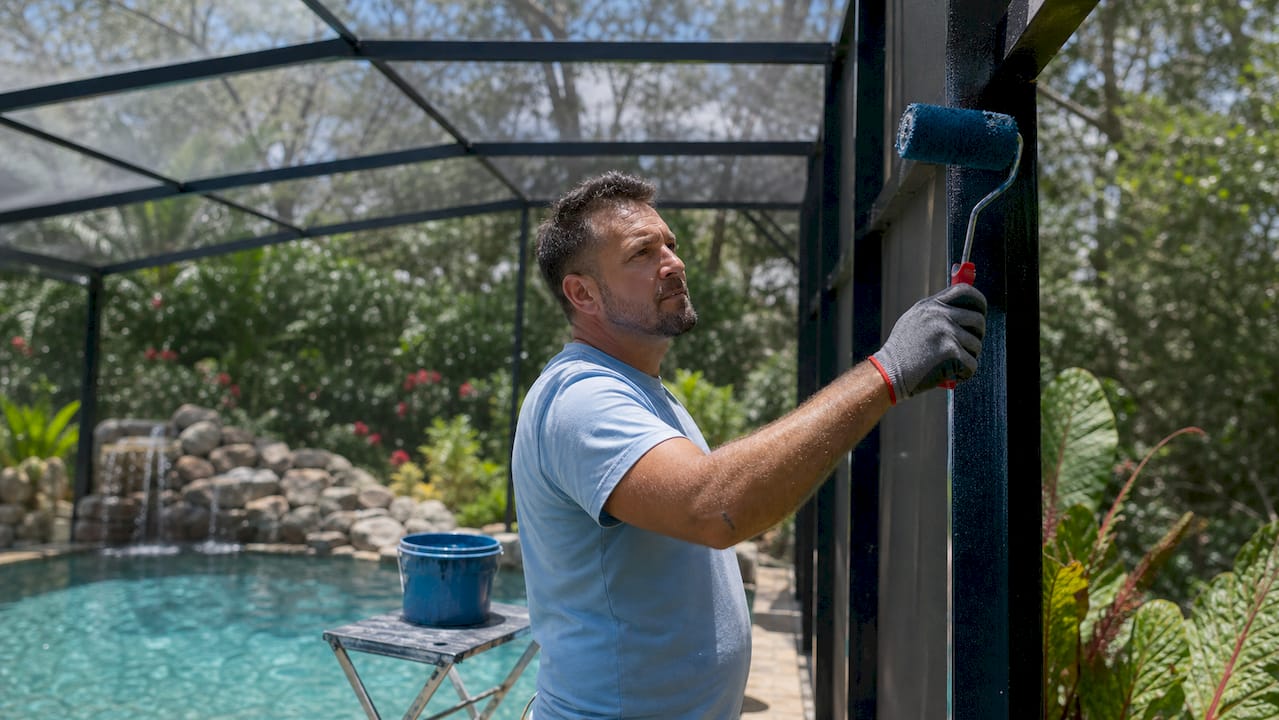
Pool cage painting is an aluminum restoration process, not a typical paint job. It demands specialized labor to treat corrosion, protect delicate screen panels, and coat narrow beams and joints that a standard roller cannot reach. That distinction explains why pricing varies so widely from one enclosure to the next.
The main cost drivers include:
- Enclosure size and geometry. A small lanai under 500 square feet typically stays under $1,800. A large Mansard-style cage with steep angles and extra linear footage can exceed $4,500. Complex geometry means more masking and hand-spraying, which adds labor hours directly.
- Frame condition. Heavy oxidation, chalky surfaces, and active corrosion require mechanical cleaning and chemical treatment before any paint goes on. A frame in poor condition can add several hundred dollars to the prep phase alone.
- Labor intensity. Labor accounts for 70% to 85% of total project cost. That figure reflects the time required to mask screens and pool decks, spray tight corners, and clean up thoroughly after the job.
- Paint and coating quality. Corrosion-resistant coatings cost more per gallon than standard exterior paint. In coastal Florida, they are not optional. Cheaper paints fail within two years under salt air exposure.
- Structural repairs. If posts, beams, or gutters need attention before painting, those costs stack onto the base price. Combining repairs with painting in one visit saves mobilization costs.
- Regional location. Coastal proximity raises the price estimate for pool cage painting. Painters working near the Gulf charge more because the job demands more prep and better materials.
Pro Tip: Ask every contractor for a flat-rate project bid, not an hourly or per-square-foot estimate. Flat-rate pricing accounts for setup, masking, prep, and cleanup in a way that simple calculations cannot capture, and it protects you from surprise charges mid-project.
How do regional and environmental conditions affect pool enclosure painting prices?
Florida is not a uniform market for pool cage work. A homeowner in Tampa Bay pays a meaningfully different pool enclosure painting price than one in an inland county, and the reason comes down to what the environment demands from the coating.
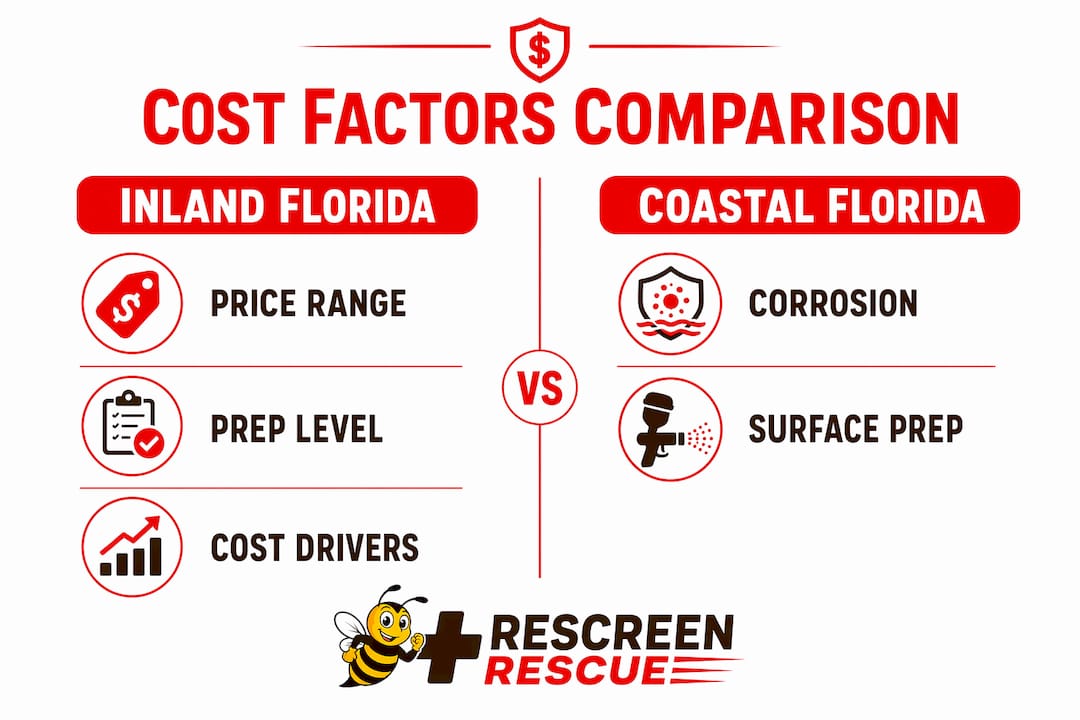
In coastal regions like Tampa Bay, painters charge $3 to $7.50 per square foot for aluminum enclosure work. That is roughly 20% to 50% more than standard deck painting, which averages $2 to $5 per square foot. The premium reflects corrosion-resistant coatings and the extra masking required to protect pool water and screen mesh during application.
| Location type | Typical price range | Key cost driver |
|---|---|---|
| Inland Florida | $1,500–$3,000 | Standard prep, moderate oxidation |
| Coastal / Tampa Bay | $2,500–$7,000+ | Salt air, corrosion-resistant coatings, heavy prep |
| Large Mansard cage, coastal | $4,500–$7,000+ | Complex geometry plus coastal premium |
Salt air accelerates oxidation on aluminum frames. A frame that might need light cleaning inland can arrive at a coastal property looking chalky and pitted after just a few seasons. That means more mechanical prep time before the first coat goes on. Skipping that prep does not save money. Poor surface preparation is the leading cause of paint failure within 24 months, raising lifetime costs by 20% to 40% through early repainting.
Pro Tip: If you live within a few miles of the Gulf or Tampa Bay, budget toward the higher end of any price range you receive. The upfront cost of quality prep and corrosion-resistant coatings pays for itself by extending the coating life by several years.
What does proper pool cage painting actually involve?
The word “painting” undersells what a quality job requires. A thorough restoration follows a specific sequence, and cutting any step creates problems that show up within a year or two.
- Mechanical cleaning. Technicians scrub or sand oxidized aluminum to remove chalky buildup and loose material. This step creates a clean surface for the primer to bond to.
- Corrosion treatment. Any pitted or actively corroding sections get treated with a chemical converter before priming. Skipping this step lets corrosion continue under the new coat.
- Masking. Screens, pool decking, coping, and any nearby surfaces get covered carefully. The complex geometry of pool cages, including narrow beams, joints, and gutter edges, requires more meticulous masking than flat exterior surfaces.
- Priming. A Sherwin-Williams LOXON Acrylic Conditioner goes on before the topcoat. This layer is what separates a five-year finish from a two-year one.
- Topcoat application. Technicians hand-spray the frame in sections, working around screen panels and tight corners that a spray gun cannot reach from a single angle.
- Cleanup and inspection. Masking comes off carefully, overspray gets removed, and the finished frame gets a final inspection before the crew leaves.
Proper surface preparation is the single most important factor in how long your pool cage paint lasts. A contractor who rushes prep to lower the bid price is handing you a higher lifetime cost, not a better deal.
Common prep mistakes include skipping the corrosion treatment step, using standard exterior primer instead of a corrosion-resistant formula, and rushing masking to save time. Each mistake shortens the coating life and pushes you back into the market for another paint job sooner than necessary.
How much can repairs and additional maintenance affect total costs?
Repairs bundled with a painting project change the final number significantly. The good news is that combining work in one visit almost always costs less than scheduling separate trips.
Structural repair costs to factor into your budget:
- Corroded upright posts: Replacing a single post runs $300 to $700 depending on height and access. A cage with multiple damaged posts can add $1,500 or more to the total.
- Gutter repair and replacement: Gutter work runs $35 to $75 per linear foot. A standard cage perimeter can mean $500 to $1,500 in gutter costs alone.
- Rescreening: Full rescreening ranges from $1,200 to $4,500 depending on enclosure size and mesh type. Painting a cage with torn or sagging screens wastes money, so many homeowners rescreen and repaint in the same project.
- Hardware replacement: Latches, hinges, and door frames corrode faster than the main frame. Replacing them during a painting project adds a few hundred dollars but avoids a separate service call later.
A full restoration package covering painting, structural repairs, and rescreening typically runs $2,500 to $7,500 or more. That range reflects the wide variation in cage size and condition across Florida properties. Bundling work is cost-effective because it reduces mobilization costs and lets crews work efficiently across all tasks in one setup.
The comparison that matters most is not painting cost alone versus painting plus repairs. It is the cost of a full restoration now versus the cost of painting now, then paying for repairs separately in six months, plus the damage that can occur in between.
Key Takeaways
Pool cage painting cost in Florida ranges from $1,500 to $7,000 or more, driven primarily by enclosure size, frame condition, labor intensity, and coastal location, with quality prep and corrosion-resistant coatings determining long-term value.
| Point | Details | ||||||
|---|---|---|---|---|---|---|---|
| Cost range by size | Standard enclosures run $1,500–$4,000; large or complex cages reach $4,000–$7,000+. | ||||||
| Coastal premium is real | Tampa Bay and Gulf-area homeowners pay 20%–50% more due to salt air and coating requirements. | ||||||
Why I always tell homeowners to look past the lowest bid
The most common mistake I see Florida homeowners make is choosing a pool cage painter based on price alone. A bid that comes in $800 lower than the others almost always reflects one thing: less prep time. And less prep time means you will be back in the market for another paint job in 18 to 24 months instead of five to seven years.
Flat-rate bids are the clearest signal of a contractor who understands the job. When a painter quotes you by the hour or by a simple square-foot calculation, they are treating your cage like a fence. The geometry of a pool cage, with its narrow beams, gutter edges, and screen-adjacent surfaces, makes that approach inaccurate. A flat-rate bid tells you the contractor has actually looked at your specific structure and priced the real work involved.
Coastal homeowners in Pinellas and Hillsborough counties face a tougher environment than inland properties. Salt air does not forgive shortcuts. I have seen cages painted with standard exterior coatings start peeling within a single rainy season. Sherwin-Williams LOXON Acrylic Conditioner and topcoats are not an upsell. They are the baseline for any job that will last.
My honest advice: get three flat-rate bids, ask each contractor specifically what their prep process includes, and choose the one who gives you the most detailed answer, not the lowest number. The average cost pool cage painting project is not a commodity purchase. It is a multi-year investment in your home’s outdoor structure.
— Holly
Rescreenrescue’s approach to pool cage restoration
Rescreenrescue has served Tampa Bay homeowners across Pinellas and Hillsborough counties for over 20 years, handling pool cage painting, structural repairs, and rescreening as bundled restoration projects.
When you work with Rescreenrescue, you get a free estimate that covers the full scope: frame prep, corrosion treatment, masking, painting, and any repairs your cage needs before the first coat goes on. Their crews understand the specific demands of coastal aluminum structures and use materials rated for Florida’s salt air and UV exposure. If your cage needs rescreening alongside painting, Rescreenrescue handles both in one visit, saving you time and separate service fees. Visit Rescreenrescue to request your free estimate and get a clear, flat-rate price for your project.
FAQ
What is the average cost to paint a pool cage in Florida?
Professional pool cage painting typically costs $1,500 to $4,000 for standard enclosures, with larger or coastal cages reaching $4,000 to $7,000 or more depending on size, condition, and location.
Why does pool cage painting cost more in coastal areas?
Coastal environments like Tampa Bay require corrosion-resistant coatings and more intensive surface prep due to salt air exposure, adding roughly 20% to 50% to the price compared to inland projects.
How long does a pool cage paint job last?
A properly prepped and coated pool cage typically holds its finish for five to seven years. Poor surface preparation shortens that lifespan to 24 months or less, raising your long-term costs significantly.
Is it worth combining rescreening and painting in one project?
Yes. Bundling rescreening, which runs $1,200 to $4,500, with painting and structural repairs in one project reduces mobilization costs and avoids paying for separate service visits within a short timeframe.
How do I get an accurate price estimate for pool cage painting?
Request flat-rate bids from at least three contractors who have physically assessed your enclosure. Flat-rate pricing accounts for prep, masking, and cleanup more accurately than hourly or per-square-foot models.