


The right screen spline size comes down to one measurement: the interior width of your screen frame’s spline groove. Standard spline diameters run from 0.125" to 0.250", with 0.140" and 0.160" covering most residential window and door screens. Get that groove measurement right, and the rest of the selection process falls into place.
Here’s a quick reference for the most common sizes:
- 0.125" (1/8") — aluminum insect screen, thicker specialty mesh like PetScreen or TuffScreen
- 0.140" (9/64") — standard fiberglass insect screen, pool and patio screening, no-see-um mesh
- 0.160" (5/32") — standard fiberglass in larger frames, BetterVue, UltraVue 2
- 0.175" (11/64") — larger frame channels, some solar screening applications
- 0.190" (3/16") — wide-channel frames, TuffScreen in larger profiles
- 0.210"–0.250" — oversized or older frames, flat spline applications
One rule that trips up a lot of DIYers: thicker mesh requires smaller spline. If you’re switching from standard fiberglass to PetScreen or TuffScreen, drop down one spline size. The extra fabric thickness takes up space in the groove, and forcing a larger spline in will make installation miserable or crack the frame.
Pro Tip: Vinyl spline stretches slightly when you roll it in. If your spline is a hair oversized for the groove, that elasticity works in your favor. Polyfoam compresses more readily, which makes it forgiving for first-timers working with older frames.
What types of screen spline should you use?
Choosing the right spline shape matters as much as choosing the right diameter. Use the wrong shape and it simply won’t seat properly, no matter how good your rolling technique is.
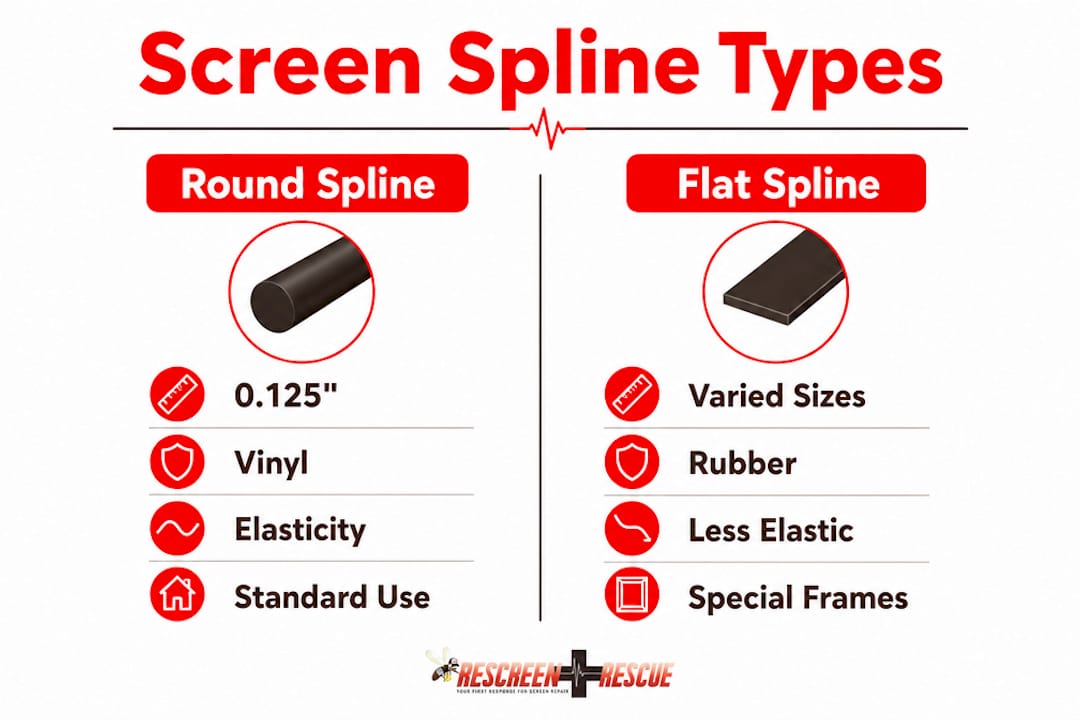
Round spline is the standard for nearly all residential window and door frames in the US. Flat spline is a different animal entirely. It’s shaped like a “D” in cross-section, and it’s used almost exclusively in Florida pool enclosure frames with specialized grooves. The two are not interchangeable. If your pool cage frame was built for flat spline, round spline will work its way out over time, especially during Florida’s afternoon thunderstorms when wind pressure builds against the screen panels.
| Spline Type | Common Diameters | Material Options | Elasticity | Best Use Case |
|---|---|---|---|---|
| Round | 0.125"–0.250" | Vinyl, polyfoam, rubber | Moderate to high | Residential windows, doors, standard enclosures |
| Flat | 5/16" (0.315") | Vinyl | Low | Florida pool cage frames, Fast Track systems |
| T-spline | 0.160"–0.250" | Extruded vinyl | Low | Thin aluminum storm doors, sliding screen doors |
| Hollow-core vinyl | 0.140"–0.210" | Vinyl | High | General residential, preferred for tight grooves |
Vinyl is the go-to material for most Florida applications because its slight elasticity helps it wedge securely into the groove. Polyfoam compresses more readily, which makes it forgiving for beginners or when working with older frames that have slightly irregular groove widths. Rubber spline is less common but shows up in commercial applications. Phifer, one of the leading screen manufacturers, sets widely followed standards for spline sizing that most Florida suppliers stock to.
Always install new spline during a rescreening project. Vinyl hardens over time and loses its elasticity, and reusing old spline is one of the most common reasons a freshly installed screen fails within a season.
How to measure spline size correctly
Accurate measurement is the single step most DIYers skip, and it’s the one that causes the most callbacks. A ruler or tape measure won’t cut it here. The tolerances you’re working with are 0.005"–0.020", roughly the thickness of a few sheets of copy paper. You need a digital caliper or micrometer, both available for under $20.
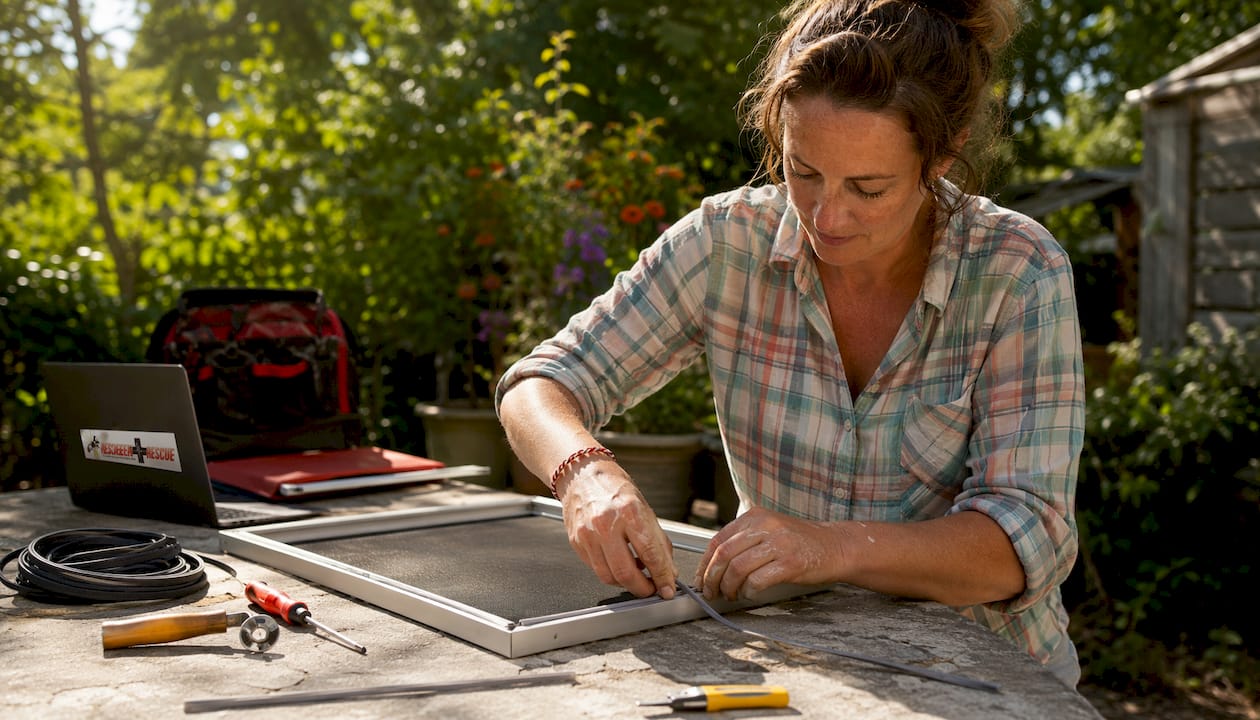
- Remove the old screen and spline first. Use a flathead screwdriver or spline removal tool to pry up one corner of the old spline, then pull it out steadily. Work slowly to avoid bending or gouging the frame’s groove walls.
- Clean the groove. Brush out any debris, old vinyl fragments, or oxidation so your caliper reads the actual groove width, not a buildup of gunk.
- Measure the groove interior width. Place the caliper jaws inside the groove and take the reading. Measure in two or three spots along the frame since older frames can vary slightly.
- Identify the groove profile. Look at the groove cross-section. A rounded U-shape takes round spline. A flat-bottomed rectangular channel takes flat spline.
- Select your spline size. For standard fiberglass mesh, choose spline that is 0.015"–0.020" larger than the groove width for a snug fit. For thicker materials like PetScreen, aim for only 0.005"–0.010" over the groove width.
- Confirm with the old spline. If you’re reusing the same frame and the same mesh type, measure the old spline with your caliper and match it exactly.
“The difference between a .175 and .185 spline is roughly 4 sheets of copy paper. It’s better to err slightly larger and stretch spline slightly for a snug fit.” — Wholesale Screens and Glass Spline Sizing Guide
If your measurement falls between two standard sizes, go slightly smaller rather than larger. Forcing an oversized spline into a tight groove can crack aluminum frames or split the corners of vinyl frames.
Tips for choosing and installing screen spline correctly
Getting the size right is half the battle. The other half is installation technique.
Tools you’ll need:
- Convex spline roller (for pressing spline into the groove)
- Concave spline roller (for seating spline in round-groove frames)
- Digital caliper or micrometer
- Flathead screwdriver or spline removal tool
- Utility knife for trimming excess spline
Common mistakes to avoid:
- Reusing old spline. It looks fine until the first strong wind, then the screen pops out.
- Pulling the screen mesh too tight before rolling the spline. Slight tension is good; overtightening causes the mesh to pucker at the corners.
- Using round spline in a flat-spline pool cage frame. It will seat initially but won’t hold under pressure.
- Buying spline at a big-box store without measuring first. Most hardware stores stock only two or three sizes, and the one you need is often not among them.
- Skipping the corner tucks. Press spline firmly into the corners before running the roller along the straight sections, or the corners will lift.
Pro Tip: When working with vinyl spline that’s slightly oversized, pull it gently as you roll it into the groove. Stretching it slightly reduces the diameter just enough to seat it cleanly without damaging the frame.
For specialty mesh like PetScreen or TuffScreen, the fabric’s thickness fills part of the groove before the spline even goes in. Dropping one size down, as Phifer recommends, prevents the spline from sitting proud of the frame surface and failing to lock the mesh in place.
Top screen repair and spline providers in Florida
Whether you’re sourcing materials or handing the job to a pro, Florida has solid options across the state.
| Provider | Service Area | Core Services | Rating | Certifications/Licensing | Warranty |
|---|---|---|---|---|---|
| A Screen Repair | Florida (statewide) | Pool/patio screen repair, installation, pet doors | 4.8★ | Licensed, insured; A+ Angie’s List | 3-year labor and materials |
| Gulf Coast Aluminum | Southwest Florida | Enclosure construction, rescreening, pool cage painting | 4.9★ (851 reviews) | State licensed; $1M+ liability and workers comp | Not publicly listed |
| Rescreen Rescue | Pinellas, Hillsborough, nearby counties | Pool cage rescreening, hardware replacement, restoration | 5★ (546 reviews) | Family-owned, 20+ years experience | Free estimates; strong workmanship guarantee |
| American Screen Solutions | Florida | Screening materials and supplies | 4.9★ (473 reviews) | — | — |
| Screenmobile | Orlando, FL | Screening supplies and services | 4.6★ (126 reviews) | — | — |
| Cutting Edge Window & Screen, Inc. | Flagler, St. Johns, Volusia, Duval counties | Retractable screens, awnings, glass replacement | 4.5★ (53 reviews) | USA-made products; financing available | Not publicly listed |
| The Screen Force LLC | Brevard County | Screen repair, full enclosure services | 5★ (41 reviews) | Family-owned and operated | Not publicly listed |
| Over The Top Screens | Bradenton, FL and surrounding area | Lanai/pool screen repair, aluminum construction, repainting | 5★ (16 reviews) | — | Not publicly listed |
| Super Screen | Fort Myers, FL | General screen repair | 4.8★ (6 reviews) | — | — |
| Phifer | National (manufacturer) | Screening materials, spline, DIY resources | — | Leading screen manufacturer | Per product |
A few providers worth noting in more detail:
A Screen Repair covers pool and patio screen work across Florida and backs every job with a 3-year warranty on labor and materials, which is the benchmark most professional Florida screen companies work toward.
Gulf Coast Aluminum operates at scale, completing numerous projects annually across Southwest Florida. Their state contractor license and $1M+ liability coverage make them a strong fit for large enclosure builds or full pool cage replacements.
Rescreen Rescue focuses specifically on Pinellas and Hillsborough counties, where the combination of salt air, intense UV, and storm season puts screen enclosures under constant stress. Their specialization in pool cage rescreening and hardware replacement, backed by over 20 years of experience, makes them the right call for Tampa Bay homeowners who want a local crew that knows Florida enclosures specifically.
Cutting Edge Window & Screen, Inc. handles a different niche: motorized retractable screens and patio shades in northeast Florida counties, with USA-made products and financing options for larger projects.
The Screen Force LLC and Over The Top Screens are solid regional operators in Brevard County and Bradenton respectively, both family-run with a personal service approach. Super Screen covers Fort Myers for general repair needs. American Screen Solutions and Screenmobile serve homeowners who want to source materials and supplies directly.
When a professional rescreening makes more sense than DIY
Measuring spline, sourcing the right materials, and rolling everything in cleanly takes time and the right tools. For a single window screen, DIY is straightforward. For a full pool cage with dozens of panels, sun-baked aluminum frames, and corroded hardware, the math shifts.

Rescreen Rescue handles exactly that kind of job across Pinellas, Hillsborough, and neighboring Florida counties. Free estimates, experienced crews who know Florida enclosure frames inside and out, and a focus on getting the job done right the first time. If your pool cage is overdue for rescreening or you’re dealing with popped panels after a storm, get a free estimate and skip the weekend project.
FAQ
How can I tell what size screen spline I need?
Measure the interior width of your screen frame’s spline groove with a digital caliper, then choose spline that is 0.015"–0.020" larger than that measurement for standard fiberglass mesh, or 0.005"–0.010" larger for thicker materials like PetScreen.
What are the most common spline sizes?
The most widely used sizes for residential screens are 0.140" and 0.160" for standard fiberglass mesh; 0.125" is recommended for thicker specialty screening products like PetScreen or TuffScreen.
Is all screen spline the same?
No. Spline comes in round, flat, and T-shaped profiles, and each is designed for a specific frame groove type. Round spline is standard for most residential windows and doors; flat spline is used in Florida pool enclosure frames and is not interchangeable with round.
How do I determine the right spline size for a pool screen?
Check whether your pool cage frame uses flat or round spline by examining the groove profile, then measure the groove width with a caliper. Most Florida pool enclosures use flat spline at 5/16" (0.315"), though some systems accept round spline in the 0.140"–0.160" range.
Key Takeaways
Selecting the correct spline diameter by measuring your frame’s groove width is the single most important step in any screen repair or rescreening project.
| Point | Details |
|---|---|
| Match spline to groove width | Choose spline 0.015"–0.020" larger than your groove for standard mesh; 0.005"–0.010" for thicker materials. |
| Most common sizes | 0.140" and 0.160" cover most residential screens; 0.125" is recommended for thicker screening mesh such as PetScreen or TuffScreen. |
| Round vs. flat spline | Round spline fits most residential frames; flat spline is required for Florida pool cage frames and is not interchangeable. |
| Always replace old spline | Vinyl hardens and loses elasticity over time, causing screen tension failure if reused during rescreening. |
| Rescreen Rescue | Serves Pinellas and Hillsborough counties with pool cage rescreening, hardware replacement, and free estimates. |