


TL;DR:
- Most Florida homeowners spend between $1,200 and over $4,500 to rescreen or repair their lanai enclosures, depending on size and complexity. A full estimate considers surface area, mesh type, structural repairs, and local conditions, with expert installation offering longer-lasting results suited for Florida’s climate. Professional services ensure proper materials, correct tension, and structural integrity, reducing long-term costs and failure risks.
Most Florida homeowners pay to rescreen or repair a lanai, with partial panel fixes on the low end and large or hurricane-grade enclosures pushing higher. A small patio rescreen typically costs between $1,200 and $1,500, while a standard residential pool cage full rescreen often runs $1,000–$3,000, and large, custom, or two-story enclosures with structural repairs can reach $4,500 or more. Materials like Phifer fiberglass or Super Screen affect the final number, and so does whether your frame needs work before a single panel goes in.
Here’s what to have ready before calling for a quote:
- Approximate enclosure dimensions (length × width × height)
- Photos of damaged panels, visible rust, or loose anchors
- Note of any door problems or hardware issues you’ve noticed
- Whether the enclosure is single-story or two-story
Pro Tip: Rescreen Rescue offers free on-site estimates across Pinellas, Hillsborough, and neighboring counties. An in-person inspection is the only way to get an accurate number — photos help speed things up, but they can’t replace eyes on the frame.
How is a lanai screening quote calculated?
Every estimate you receive should break down into clear line items. When one doesn’t, that’s a red flag.
| Cost Component | Typical Range |
|---|---|
| Labor (installation) | $1.50–$3.50 per square foot installed, with some Florida contractors quoting up to $7–$9 per square foot when measuring full screen surface area including walls and soffits |
| Old mesh removal and disposal | Often bundled; sometimes a standalone cost |
| Hardware (latches, hinges, closers) | Starting at a standalone cost; often bundled |
| Door tuning and adjustment | Typically bundled with full rescreen |
| Structural frame repairs | Variable; quoted separately when needed |
| Travel or service fee | $100 minimum for small jobs |

One thing that surprises homeowners: contractors don’t price by your enclosure’s floor footprint. They measure the actual screen surface area, which includes all four walls and the roof panels. A 20×40 pool cage footprint can translate to 1,800–2,200 square feet of screen surface once you account for walls and soffits. Some Florida contractors quote $7–$9 per square foot on that full surface area, which is why published estimates can look dramatically different from each other even for the same-size enclosure.
Pro Tip: Ask every contractor to show you how they measured. A quote based on floor footprint alone will be lower than one based on actual screen surface — and the latter is the honest number.
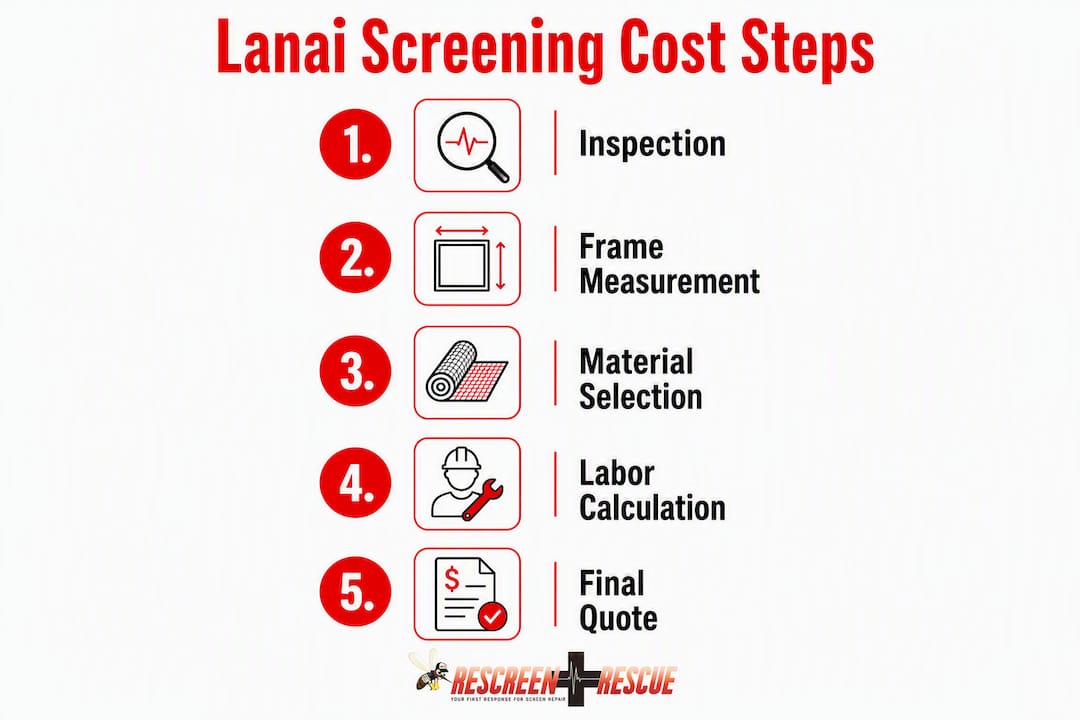
What do real Florida lanai rescreen jobs actually cost?
These scenarios reflect common project types in the Tampa Bay area. Structural repairs are noted separately because they’re the most common source of budget surprises.
| Scenario | Approx. Screen Area | Mesh Type | Structural Repairs? | Estimated Cost |
|---|---|---|---|---|
| Small partial rescreen (2–4 panels) with standard fiberglass mesh and no structural repairs typically cost a few hundred dollars. | ||||
| Single-story pool cage full rescreen with standard fiberglass mesh and no structural repairs typically costs several thousand dollars. | ||||
| Standard pool cage with hardware refresh and minor structural repairs typically costs multiple thousand dollars. | ||||
| Large or custom enclosures with fiberglass or Super Screen mesh and no structural repairs can cost several thousand dollars. | ||||
| Two-story or mansard roof enclosures with standard or premium mesh and structural repairs can be more costly beyond several thousand dollars. | ||||
| Hurricane-grade upgrades with Super Screen or TuffScreen mesh often add a substantial cost increase to the base price. |
A few things worth knowing about these numbers:
- Individual panel repairs cost $100–$400 each, but once more than roughly 30% of your panels are damaged, a full rescreen—typically $1,200–$3,000 for standard pool enclosures—is more cost-effective than fixing panels one at a time.
- Two-story and mansard-roof jobs take longer because of scaffold setup and access complexity, which adds to labor cost.
- Super Screen and TuffScreen options cost more upfront but can last up to 20 years versus 8–12 years for standard fiberglass, making them a sensible long-term choice in Florida’s UV-heavy climate.
Eight things that make two quotes for the same job differ
You can get two estimates for the same enclosure and see a $1,500 gap. Here’s why.
- Screen material and grade. Standard fiberglass is the most affordable. No-see-um mesh, pet-resistant screen, and Super Screen each step up in price and durability. Choosing the right fiberglass vs. aluminum screen for your exposure matters.
- Enclosure height and complexity. Taller cages require ladders or scaffolding, which adds setup time and cost.
- Frame condition and hidden structural repairs. Loose anchors, corroded fasteners, and bent frame members must be fixed before rescreening. Skipping this step leads to premature failure in high winds.
- Spline size and replacement. Using the wrong spline size is one of the most common DIY mistakes. Professionals match spline to channel width precisely.
- Hardware and door work. Latches, hinges, and closers add to the total when they need replacement or adjustment.
- Hurricane-rated upgrades. Coastal counties in Florida have wind-load requirements that may mandate specific mesh ratings and fastener specs.
- Accessibility and setup time. Tight pool decks, landscaping, or overhead obstructions slow installation.
- Warranty and labor guarantee. A contractor offering a multi-year workmanship warranty prices that coverage into the job.
Pro Tip: Ask your contractor to list structural repairs as a separate line item on the written estimate. That way, if the frame turns out to be in better shape than expected, you can see exactly what drops off the total.
Why professional installation matters more in Florida
Florida’s combination of year-round UV exposure, high humidity, and frequent storm activity is genuinely harder on screen enclosures than almost anywhere else in the country. DIY repairs are more likely to fail in this climate because they often use the wrong spline size, insufficient mesh tension, or fasteners that corrode quickly.
Professionals bring several advantages that matter specifically here:
- Correct spline selection and tensioning for Florida’s wind conditions
- Wind-rated mesh installation that meets local building codes
- Structural anchor inspection before any screen goes in
- Access to commercial-grade materials not sold at retail
- Experience identifying frame corrosion before it becomes a structural failure
Rescreen Rescue brings over 20 years of experience to every job in Pinellas and Hillsborough counties, with free on-site estimates and a commitment to inspecting the frame before recommending any screen work. For two-story enclosures, extensive frame corrosion, hurricane-grade upgrades, or any job that requires a permit, professional service isn’t just convenient — it’s the only path to a result that holds.
How to get an accurate on-site estimate
A thorough estimator will inspect more than just the torn panels. Here’s the full checklist of what a proper site visit covers:
- Frame anchor condition at the slab and roof line
- Fastener corrosion on all frame members
- Door operation, latch function, and closer tension
- Mesh age and overall tension across panels
- Total enclosure footprint and height measurement
- Roof style (flat, hip, mansard) and soffit access
- Any visible bowing, cracking, or separation in aluminum members
Before the estimator arrives, send clear photos of damaged panels, close-ups of any visible rust or anchor points, and a full-enclosure shot from outside. It won’t replace the inspection, but it helps the estimator come prepared.
Questions to ask before signing anything:
- What is the warranty on both materials and labor?
- What brand and gauge of mesh are you using?
- Does the price include hardware replacement and door adjustments?
- Are structural repairs listed as a separate line item?
- Does this job require a permit, and who pulls it?
What the timeline looks like from first call to finished job
- Initial contact and photo review — same day or next business day
- On-site inspection and written estimate — typically within 2–5 days of contact
- Material ordering — 1–3 days for standard mesh; longer for specialty orders
- Old mesh removal — half a day to a full day depending on enclosure size
- Screen installation — 1 day for small cages, 2 days for medium, 2–3 days for large or complex jobs
- Hardware tuning and door adjustment — usually completed same day as installation
- Cleanup and final walkthrough — included at job completion
Small cages often finish in one day, medium jobs in two, and large or structurally complex enclosures in two to three days. Structural repairs extend the schedule because they may require additional materials or a return visit for frame work.
Pro Tip: Book before May if you want your enclosure ready before peak hurricane season. Scheduling fills up fast in spring, and material lead times can stretch when demand spikes.
DIY vs. professional: where the line is
Some tasks are genuinely manageable for a careful homeowner. Others carry real risk.
DIY is reasonable for:
- Replacing a single small panel on a ground-level enclosure with a sound frame
- Swapping a worn spline on a low section you can reach safely
- Basic screen door latch tightening or adjustment
Always hire a professional for:
- Any frame repair, anchor work, or structural correction
- Two-story or mansard-roof enclosures
- Hurricane-grade mesh installation that must meet code
- Jobs covering more than 30% of panels (full rescreen economics favor a pro)
- Any work requiring a permit
The short-term savings from DIY can disappear quickly. Wrong spline sizing, improper tension, or missed frame corrosion means the screen fails in the next storm and you pay mobilization costs twice. In Florida’s climate, a professional rescreen done right the first time is almost always the better financial decision over a two-year horizon.
Pro Tip: Between professional visits, rinse your screens with a garden hose every few months to remove salt air deposits and debris. It’s the single easiest thing you can do to extend screen life.
Key Takeaways
Professional rescreening in Florida costs several thousand dollars for most standard pool cages, with structural repairs and hurricane-grade upgrades increasing costs for larger jobs.
| Point | Details |
|---|---|
| Typical cost range | Most Florida lanai rescreens fall between $1,200 and $4,500 or more, with larger, custom, or two-story jobs commonly reaching the high end or exceeding this range. |
| Full rescreen threshold | When more than 30% of panels are damaged, a full rescreen costs less per panel than individual repairs. |
| Hidden cost to watch | Structural frame repairs are the most common budget surprise; always request them as a separate line item. |
| Material lifespan | Standard fiberglass lasts 8–12 years; Super Screen and TuffScreen options can reach 20 years. |
| Rescreen Rescue | Offers free on-site estimates across Pinellas, Hillsborough, and neighboring counties with 20+ years of experience. |
What Rescreen Rescue sees on every job
Every estimate we provide starts with a full frame inspection, not just a look at the torn panels. After more than 20 years working on pool cages and screen enclosures across Pinellas and Hillsborough counties, we’ve learned that the screen is rarely the whole story. Loose anchors, corroded fasteners, and soft frame members show up regularly on enclosures that look fine from the street. Rescreening over a compromised frame is a short-term fix that fails at the worst possible time.
Our approach is straightforward: inspect first, quote honestly, and use materials matched to Florida’s actual conditions — correct spline sizing, wind-rated mesh where codes require it, and hardware that holds up to salt air. Free estimates mean you get a written breakdown before committing to anything.
Rescreen Rescue serves Pinellas, Hillsborough, and neighboring counties
Rescreen Rescue handles the full range of enclosure work: rescreening, spline replacement, structural repairs, hurricane-grade mesh upgrades, door and pet door installation, hardware replacement, and frame restoration. Whether you have two torn panels or a full enclosure that hasn’t been touched in fifteen years, the process starts the same way: a free on-site estimate with a written, itemized quote.
Service covers Pinellas County, Hillsborough County, and surrounding areas throughout the Tampa Bay region. To get your estimate, contact Rescreen Rescue with your enclosure photos and dimensions, and a technician will schedule an on-site visit. No guessing, no surprise line items — just a clear number and a plan to get your lanai back in shape.
FAQ
How much does it cost to screen in a lanai in Florida?
Most Florida homeowners pay several thousand dollars for a professional rescreen, with partial repairs costing less and large or hurricane-grade jobs costing more. The final number depends on enclosure size, mesh type, and whether structural repairs are needed.
Is it cheaper to repair panels or do a full rescreen?
Individual panel repairs cost $100–$400 each, but once more than roughly 30% of panels are damaged, a full rescreen usually becomes more cost-effective, with total costs for standard residential enclosures typically $1,200–$3,000 depending on size and mesh type.
What mesh lasts longest in Florida’s climate?
Super Screen and TuffScreen options last significantly longer than standard fiberglass in Florida conditions, offering better durability. They cost more per square foot upfront but reduce the frequency of full rescreens.
Does a lanai rescreen require a permit in Florida?
Permit requirements vary by county and project scope. Structural repairs and new enclosure frame-ins typically require a permit; straight mesh replacement on an existing frame often does not. Ask your contractor to confirm permit requirements for your specific job before work begins.
How long does a professional lanai rescreen take?
Small enclosures typically finish in one day, medium jobs in two days, and large or structurally complex enclosures in two to three days. Structural repairs can extend the schedule depending on the scope of frame work required.