

Your pool enclosure is a huge part of the Florida lifestyle, but how can you tell when it’s time to call in a pro? It's not always about the big, obvious rips. Sometimes, the quieter signs—like brittle screen material or panels pulling away from the frame—are telling you a simple patch job just won't cut it.
Learning to spot these early warning signs is the key to knowing when to search for pool cage screen repair near me, and it can save you from a much bigger, more expensive headache down the road.
Is It Time For A Professional Pool Cage Repair?
Your pool cage is in a constant fight with Florida’s sun, humidity, and surprise storms. Over time, even the best materials start showing their age. A quick walk-around inspection every few months is your best defense to catch problems while they’re still small.
Start With the Screen Itself
First, get a feel for the screen material. Does it feel brittle when you touch it? Is it chalky? A healthy screen will have a bit of give to it. Years of sun exposure bake the protective coating right off the fiberglass mesh, making it fragile and ready to tear at the slightest pressure. That brittleness is a dead giveaway that the screen is on its last legs.
Next, check where the screen meets the frame. Do you see any gaps or screens pulling away from the aluminum? Take a close look at the spline—that rubber gasket holding the screen tight. UV rays cause the spline to shrink and harden over time, making it lose its grip. A loose screen basically defeats the whole purpose of the enclosure, letting in every mosquito and leaf in the neighborhood.
Don't Forget the Bones of the Structure
Beyond the mesh, the hardware and frame need a once-over. Look at the screws and fasteners, especially at the base of the cage and where the big aluminum beams connect.
See any rust or corrosion?
Those rusty screws aren't just an eyesore leaving stains on your pool deck; they are a serious weak point. A single strong gust of wind during a summer storm can pop those corroded fasteners right out.
Also, take a step back and sight down the long aluminum beams of the frame. Do you notice any sections that are bending or bowing? Minor dings happen, but a significant bend is a red flag for structural stress that absolutely needs an expert eye.
A bent frame or widespread rust isn't just a cosmetic problem—it's a safety hazard. These are the kinds of issues that tell you it’s time to get a professional evaluation before the next storm season rolls in.
Knowing When to Make the Call
Figuring out the difference between minor wear and a critical problem will save you a ton of time and money. For instance, you can probably live with a single small tear for a while. But when you start seeing multiple tears across different panels, combined with that brittle feel and loose splines, calling a pro is the smartest move you can make.
Here in Tampa Bay, putting off repairs is a gamble. After Hurricane Ian, repair demands shot up by as much as 40% in coastal counties as thousands of enclosures were shredded. The data doesn't lie: untreated tears can lead to 70% more bugs and debris getting into your pool, costing you hundreds, if not thousands, in extra cleaning and chemicals over time.
Once you’ve spotted several of these issues, it’s time to find a reputable local expert to come out for a proper inspection. To get a better handle on what you're seeing, check out our detailed guide on common screen issues and solutions.
Panel Patch Or Full Rescreen: Which Is Right For You?
So, you've taken a good, hard look at your pool enclosure and spotted some issues. Now comes the big question: do you just patch up the few bad spots, or is it finally time to rescreen the entire structure?
Honestly, there's no single right answer. The best move really depends on the age of your screens, how much damage you're dealing with, and what makes sense for your budget in the long run.
A single panel repair is the clear winner for isolated incidents. Maybe a stray golf ball from the neighbor's yard left a perfect hole in one panel, or a heavy branch came down in a storm and tore another. If the rest of your screens are still in great shape—flexible, dark in color, and holding tight—a targeted repair is your fastest and most wallet-friendly fix. No need to replace what isn't broken.
When The Damage Is More Widespread
The story changes, though, when the problems are scattered all over the enclosure. If your screens have been baking in the Florida sun for over 10 years, they’re likely nearing the end of their life. You'll start to notice several panels look faded, feel brittle when you touch them, or have a bunch of small tears and rips.
Patching one panel today just means you'll probably be calling someone to fix another one next month, and another the month after that. It's a frustrating cycle that I call "death by a thousand cuts." Before you know it, the money you've spent on all those individual repairs starts adding up to what a full rescreen would have cost in the first place.
This decision tree gives you a simple visual to follow. It'll help you figure out if you should just keep an eye on things or start getting quotes from a pro.
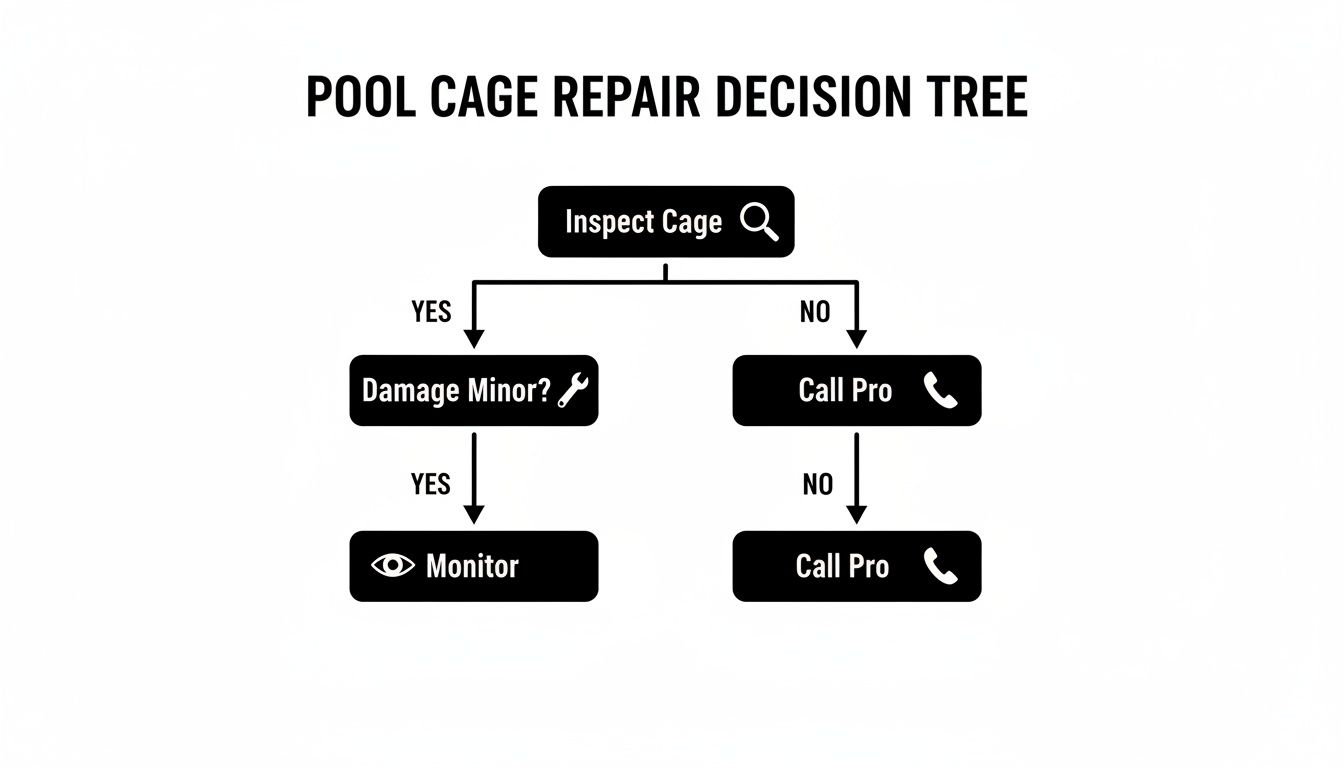
This flowchart just simplifies things, guiding you through an inspection to see if the damage is just a one-off or a sign of a bigger problem. It points you toward the most logical next step for your situation.
Thinking About Long-Term Value
A full rescreen gives you benefits that piecemeal repairs just can't. It brings your entire enclosure back to brand-new condition, with every single panel matching in color, strength, and protective quality. Not only does this make your whole outdoor space look fantastic, but it also buys you peace of mind. You won't be constantly wondering which old panel is going to fail next.
This quick guide breaks down the decision-making process, highlighting when each option makes the most sense for homeowners.
When to Choose a Single Panel Repair
- Best For: Isolated damage (1-3 panels), newer enclosures (< 7 years old), or storm/impact damage.
- Cost: Low initial cost per panel, but can add up over time with multiple repairs.
- Appearance: New panel may not perfectly match the color and texture of older, faded screens.
- Durability: Fixes the immediate problem but doesn't address the age of surrounding panels.
- Timeline: Quick fix, often completed in under an hour.
When to Choose a Full Rescreen
- Best For: Widespread damage, brittleness, fading, or enclosures over 10 years old.
- Cost: Higher upfront investment, but more cost-effective in the long run for aging screens.
- Appearance: Provides a uniform, brand-new look across the entire enclosure.
- Durability: Restores the entire structure to peak condition, with a fresh warranty.
- Timeline: Typically takes a full day or two, depending on the size of the enclosure.
Ultimately, choosing between a patch and a full rescreen comes down to an honest look at your enclosure's overall health. If you're dealing with a couple of small, isolated holes on an otherwise healthy cage, a panel replacement is a perfect solution.
For those smaller DIY fixes around the house, you might find our guide on how to repair window screen holes useful. But if you see signs of systemic aging and widespread wear, a complete rescreen is hands-down the smarter long-term investment.
Decoding Pool Cage Repair Costs In Tampa Bay
Alright, let's talk numbers. Budgeting for your pool enclosure repair shouldn't be a guessing game, especially when you're just trying to find a fair price for "pool cage screen repair near me." This breakdown will give you a clear look at typical costs here in the Tampa Bay area, so you can look at quotes with confidence and know exactly what you’re paying for.
Breaking Down Single Panel Replacements
When it comes to replacing just a single screen panel, the cost hinges on a couple of key variables. The two biggest factors are the type of screen you pick and where that panel is located on the cage itself.
A standard fiberglass screen will be your most budget-friendly option. On the other hand, a premium choice like a durable pet screen costs more upfront but gives you far better tear resistance.
Accessibility is a huge deal, too. A ground-level wall panel is a quick and safe fix. But a high roof panel? That’s a different story. It requires specialized ladders and extra safety measures, which naturally adds to the labor cost. Technicians have to work carefully to get a taut, secure fit high above your pool deck.
The Cost of a Full Rescreen Project
When your enclosure has more than a few problem spots, a full rescreen is often the most sensible investment. This kind of job is typically priced by the total square footage of the enclosure's surface area—not just the square footage of your patio. Think of it as the sum of all the wall and roof panels combined.
Here in Tampa Bay hotspots like Bradenton and Manatee County, you can expect a full rescreen to cost between $7 to $9 per square foot. For a common 600-square-foot enclosure, that means you might be looking at a range from $4,200 to $5,400. This price reflects the intensive labor and quality materials needed to bring your entire cage back to looking brand new.
Smart homeowners don't see a full rescreen as just another repair; they see it as a long-term investment. Yes, it's a significant outlay, but it stops that frustrating cycle of small, nagging repair bills that really add up over time.
For a deeper dive into what goes into these numbers, check out our complete guide to pool screen repair costs.
Valuable Add-Ons That Extend Your Investment
Beyond just the screen, any reputable company will offer services that protect the entire structure. These aren't just upsells; they are smart upgrades that can add years to your enclosure's life.
- Fastener Replacement: This is critical. Swapping out old, rusted screws for new, corrosion-resistant hardware prevents those ugly rust stains and seriously strengthens the cage's integrity. It's a must-do for withstanding Florida's high winds.
- Pressure Washing: Before new screens go on, a professional pressure washing blasts away years of built-up grime, algae, and mildew from the aluminum frame. This not only ensures a clean surface for the new screen but also gives your property an instant curb appeal boost.
- Frame Painting: A fresh coat of paint on the aluminum frame can extend its life by 5-7 years and completely revitalize the look of your entire outdoor space.
Investing in these add-ons at the same time as a rescreen is a strategic move. For instance, just replacing the fasteners alone can run anywhere from $1,000 to $2,500. Doing it during a rescreen prevents future structural failures that could lead to much costlier damage—and maybe even a hike in your homeowner's insurance premiums.
How To Find A Reputable Local Screen Repair Company
A quick search for "pool cage screen repair near me" is going to give you a laundry list of options, especially here in the Tampa Bay area. It can feel like a lot to sort through, but figuring out who’s a real pro and who’s just a guy with a truck is easier than you think. A few simple checks will help you hire someone who actually stands behind their work.
First thing's first: never hire a contractor who isn't fully licensed and insured. This isn't just a formality—it's your safety net. A license shows they're legitimate and meet local standards, while insurance protects you from liability if someone gets hurt on your property or causes accidental damage. If they can't show you proof, move on. No exceptions.
Dig Into Recent Customer Experiences
Once you've confirmed their credentials, it's time to play detective and see what real customers are saying. Recent online reviews are your best friend for getting a feel for a company's day-to-day performance. Don't just glance at the star rating; dive into the actual comments.
Look for patterns in what people mention:
- Punctuality: Did they show up when they said they would? Chronic lateness is a bad sign.
- Communication: Were they easy to get ahold of? Did they keep the customer in the loop?
- Workmanship: Do people mention a clean, tight screen installation? Did they clean up the old materials and stray screws afterward?
- Professionalism: Was the crew courteous and respectful of the homeowner's property?
Consistent praise in these areas is a huge green flag. It tells you this is a business that cares about its reputation. In fact, for any home service, online reviews are now one of the biggest trust signals. Understanding the basics of SEO for contractors can even give you insight into which companies are serious about building and maintaining a positive local presence.
Get Everything In Writing
Any reputable contractor will hand you a detailed, written estimate before asking for a commitment. This document should be more than just a single number at the bottom. It needs to break down the costs for materials, labor, and any extras like replacing rusty fasteners or pressure washing.
A vague quote scribbled on a business card or a "we'll figure it out" verbal agreement is a massive red flag. A professional, itemized estimate protects everyone involved by setting clear expectations from the start.
Finally, always ask about the warranty. A solid warranty shows that a company has faith in its materials and the skill of its team. It’s your guarantee that they’ll stand behind their work long after the job is done. Knowing what’s covered—and for how long—is a critical piece of the puzzle.
To get a better idea of what a comprehensive job looks like, check out our guide on what a professional screen enclosure repair should include. Taking these steps will help you hire the right team with total confidence.
What To Expect During The Screen Repair Process
So you’ve found a pro, signed on the dotted line, and scheduled the job. Awesome! But what actually happens on repair day? Knowing the play-by-play for a professional screen repair can take all the guesswork out of it, leaving you feeling confident and stress-free.
Whether it's a couple of torn panels or a full-blown rescreen, the core principles of quality work don't change.
For a Single Panel Repair
If you’re just dealing with one or two problem spots, the fix is refreshingly quick and efficient. A technician will show up with everything they need—tools, screen, spline—ready to get straight to work.
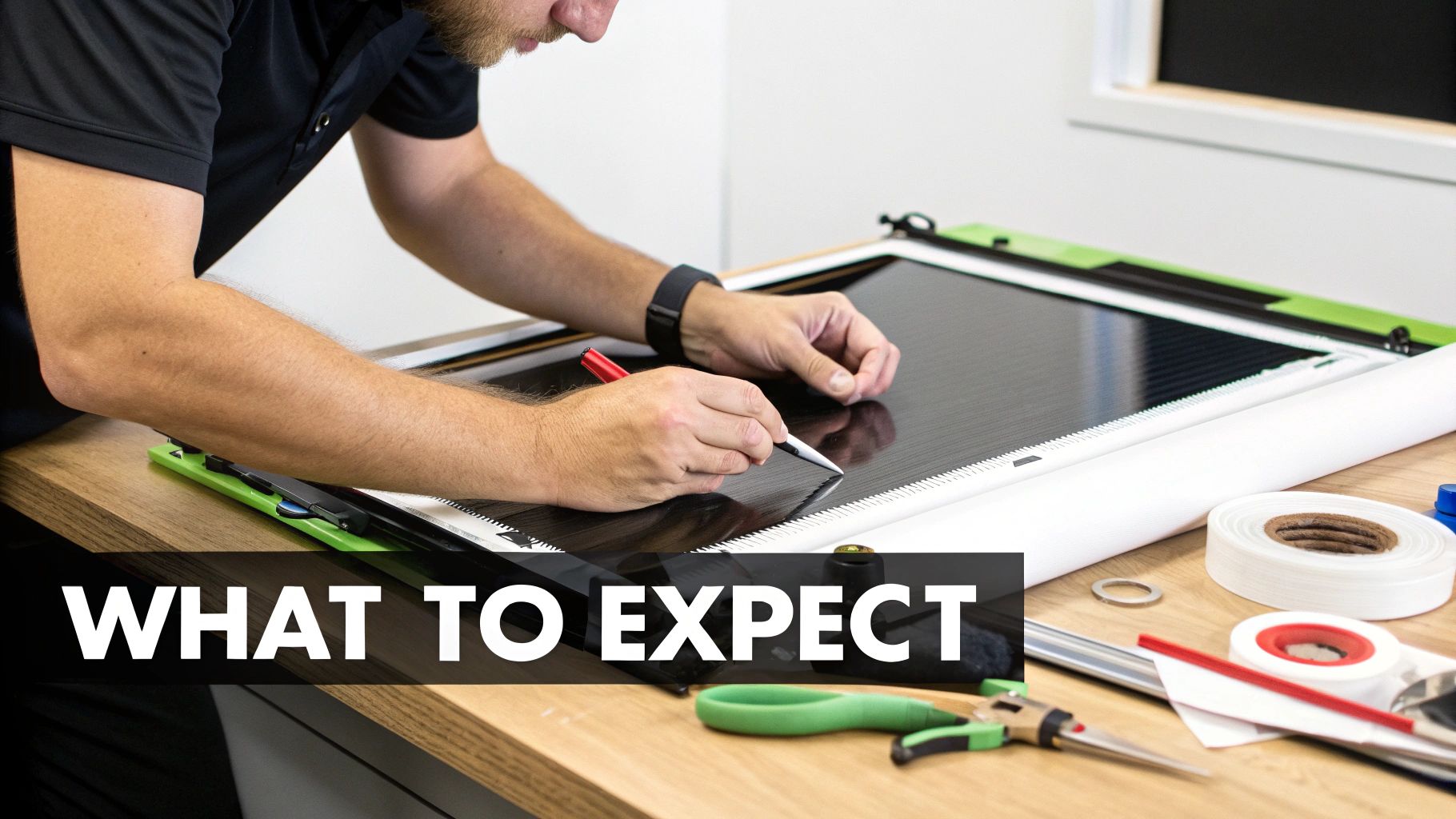
First, they'll carefully pull out the old, damaged screen and the dried-out spline holding it in. Then, they’ll measure and cut a new piece of screen for a perfect, custom fit. The last step is the real craft: rolling the new screen and spline into the frame's channel to create that signature taut, drum-tight finish. The whole process for a few panels is usually wrapped up in under an hour.
What A Full Rescreen Involves
A full rescreen is definitely a bigger project, but a good crew runs it like a well-oiled machine. They'll start by systematically tearing out every single old screen panel and all the brittle spline from the entire enclosure. This is the perfect time for them to give the aluminum structure a good once-over, checking for any corrosion or loose screws that need tightening.
With the frame prepped, the team gets to work installing the new screens, one panel at a time. They move methodically around the cage, making sure every new section has just the right amount of tension. This is what separates professional work from a weekend DIY attempt—that consistent, clean, and uniform look across the whole structure.
A professional crew doesn’t just replace the screen; they restore the integrity and look of your entire outdoor space. The meticulous cleanup and final walkthrough are just as important as the installation itself.
Timelines And The Final Touches
So, how long will your pool be out of commission? It all depends on the scope. As I mentioned, a few panel repairs are super quick. A full rescreen of a standard-sized pool cage, on the other hand, is usually a full-day job. For those really large or complex cages, it might stretch into a second day.
No matter the size of the job, a true professional team will always finish with a thorough site cleanup. They'll haul away every scrap of old screen, discarded spline, and any other debris. Your pool deck should look just as clean as it did when they arrived, if not cleaner.
Before they pack up, you should always expect a final walkthrough with the crew leader. This is your chance to inspect the work up close, ask any last-minute questions, and make sure every detail is perfect. Any reputable company will want to know you are 100% satisfied before they consider the job done.
Want to dive deeper into the process? Check out our complete guide on rescreening a pool enclosure.
Common Questions About Pool Cage Screen Repair
Even after you've decided to tackle your screen issues, a few questions are bound to pop up. We get it. Here are some straightforward answers to the things Tampa Bay homeowners ask us most when they start looking for "pool cage screen repair near me."
How Long Does A Pool Cage Screen Last In Florida?
In our intense Florida climate, a standard fiberglass screen usually gives you a good 10 to 15 years. But let's be honest, that number can shrink fast. Constant, direct sun exposure is a killer, and if you're in a coastal community like St. Petersburg, the saltwater in the air definitely speeds up wear and tear. And of course, tropical storms don't help.
You'll know it's time for a change when the material gets brittle to the touch. If it tears with just a little bit of pressure or has that chalky, faded look, its best days are behind it. When you start seeing these signs across multiple panels, a full rescreen is almost always the smartest, most cost-effective move.
Can I Just Patch A Small Hole Myself?
For a tiny hole—we're talking smaller than a quarter—sure, a DIY adhesive patch kit from the hardware store can work as a quick, temporary fix. It'll keep the bugs out for a little while. But these patches are often pretty obvious and don't stand up well to our rain and sun.
Anything bigger than that, though? If you have multiple damaged spots, or if the screen is pulling away from the frame (the spline is coming out), you really need a professional repair. A pro uses specialized tools to get the tension just right, giving you that seamless, durable look a DIY patch just can't deliver.
What’s The Best Type Of Screen For My Pool Cage?
While the standard 18/14 mesh fiberglass screen does a fine job against most common insects, many Florida homeowners are upgrading to specialty screens for some serious extra benefits. The right choice really comes down to your lifestyle and what drives you nuts the most.
Here are a few of the most popular options we install:
- Pet Screen: This stuff is a game-changer if you have dogs or cats. It's much thicker and tougher, designed to stand up to claws and teeth. It’s a fantastic investment that saves you from constant repairs.
- Solar Screen: Also called a sun screen, this mesh is built to block a higher percentage of the sun's harsh UV rays. It makes a noticeable difference in keeping your patio area cooler and stops your outdoor furniture from fading.
- No-See-Um Screen: With a much tighter weave, this screen is specifically made to keep out those tiny, annoying no-see-ums that can plague us here in Florida. If you've ever been driven inside by them, you know how valuable this is.
A good local company can walk you through the pros and cons of each, helping you pick the perfect material for your enclosure and your family.
A pristine, well-maintained pool enclosure is a major selling point in the Florida real estate market. It's not just a feature; it's an extension of the home's living space.
Does A New Screen Really Increase My Home Value?
Absolutely. In Florida, a beautiful and functional outdoor living space is a huge magnet for potential buyers. A pool cage with torn, faded, or brittle screens is an immediate red flag that screams deferred maintenance. You can bet it will come up during negotiations after the home inspection.
Investing in a professional rescreen instantly boosts your home's curb appeal and sends a clear signal to buyers that the property has been well cared for. It’s an upgrade that pays for itself by making your home more attractive and completely move-in ready.
Ready to get your outdoor oasis back? The team at Rescreen Rescue has over 20 years of experience providing fast, reliable screen repair and rescreening services all across Tampa Bay. We offer free, no-hassle estimates and stand behind our work with available warranties. Visit us online to get your free quote today!